

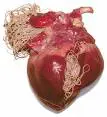
 So here's another set of questions about heartworm treatment where the answer bears repeating. This is a continuation of a dialog that began in a previous post about heartworm treatment. This fellow is out east and has adopted a stray, and unfortunately, the dog has heartworms. At present, he doesn't feel that he can take on the full recommended heartworm treatment with Immiticide to get rid of the adult worms. He has questions about the alternative of just putting the dog on heartworm preventive and trying to "hold the line".
Have you seen young, lightly infected (class 1) dogs overcome a few years of heartworms (maybe
living 2-4 yrs with them and then having no more adult worms due to preventative) and still live decently long lives?
Or is it just ridiculous to think that preventing more adult worms to come and slowly suppressing the ones she has already is okay and not cruel? I worry that just giving her Ivermectin regularly and some doxcycline will be good, but not great, and that years will be taken off her life due to heart damage.
Finally, this is an extremely active dog. She loves to run, jump, and play with our retriever. I
haven't heard her cough or seen her severely out of breath, but it seems this physical activity is not ideal. How much should we cut back? Can she play for a few minutes, or is any exertion just adding more of a chance of heart/artery damage?
Sincerely,
Jason
Hello, Jason,
The experts say that the severity of disease (actual structural damage resulting in decreased function and shortened life, versus just the presence of worms) is due as much or more to a dog's activity level as to the number of worms present.
Unless there are a huge number of worms (as in a dog that has died from the disease, which would be the picture at the top of the post), they really aren't in the heart, but rather in the pulmonary arteries, those vessels coming from the right side of the heart to the lungs (to get oxygen). If the dog is athletic and active, a more turbulent flow of blood is generated in the arteries by the higher blood pressure and more rapid heart rate. This beats up the inside of the arteries by whipping the worms around.
A relatively small number of worms can thus cause more damage in the athletic dog than would a larger number of worms in the couch-potato dog. The couch-potato dog takes it easy, has a slow heart rate, lower blood pressure, and so the worms are just floating lazily in his blood vessels. They aren't getting whipped around.
When the arteries get beat up, they become inflamed, and they swell. The swelling of the walls causes a narrowing of the open space in middle. This restricts blood flow, causing higher blood pressure in the lungs, and creating increased resistance to the heart's effort to pump blood through the vessels. The heart eventually begins to wear out from constant overwork.
The more often, and more vigorously a dog exercises, the more likelihood that even small numbers of worms will eventually cause significant damage. Unfortunately there is no way to say what magic number of worms will be safe, and even if there were, there's no way to count the worms (at least while the dog is alive).
In our area, you can count on an outside dog having some heartworms by the age of one year if he receives no medication. I have seen many dogs who received no heartworm-preventive whatever lead apparently normal lives until the age of 3 to 5 years, having good exercise tolerance and looking great. Then they begin to show outward signs of decreased exercise tolerance, which progresses eventually to congestive heart failure by less than half of a normal life-span.
SO, if your dog is young, healthy, has very few worms, and you keep giving the ivermectin each month so that he doesn't get any additional worms, then yes, she has good odds for a good quality of life for several years. If she were older, or has more worms, then not such good odds.
 So, "good odds" of a good life, but no guarantees. What did Dirty Harry say? "Do you feel lucky, punk? Well… do ya?"
It surely would be better to treat the dog for the adult heartworms.
I find this fascinating. That there are worms who target the heart, and not another organ. It’s not a very good parasite, because it kills the host.
But, am I wrong in understanding that there is no cure for heartworms-just something that keeps more from developing? Hard to believe with all the advances in science, we can’t find something that will kill a simple parasite while not harming the host.
So took my dog to the vet today and he is positive for heartworms didn’t receive a lot of details i thought on whether it was a bad case or not. All i was told she recommended a 3 step process that is over 1700 dollars is this normal or do i have any other options?
Hello, Matt, I’m sorry to be so late replying, but we had a revamp of our website and the comments were hidden until today. It is difficult for me to evaluate what your dog needs when I haven’t seen it. The standard treatment protocol from the American Heartworm Society begins with giving doxycycline for 4 weeks. This medicine inhibits Wohlbachia, a microorganism that benefits the heartworm. After taking it for one month, the worms become weaker, and actually physically smaller. This makes them easier to kill, and then there is less clogging of the arteries after the treatment. One month later, a single injection of melarsomine is given. This will kill the weaker worms (older, younger, males). You give the dog a month to get over this. The worms die, then shift downstream and clog up the blood vessels in the lungs. The white blood cells (that you can’t see without a microscope) gradually dissolve the dead worms, eating them away. It takes several weeks for this to occur. Then the dog takes the next stage of treatment, which is TWO injections, 24 hours apart. This will kill the remaining worms. Again, you give the dog 4 to 6 weeks to recover from this (restricted exercise, and many doctors also give prednisone to minimize inflammation in the lung arteries). Then you give a dose of medication to clear the microscopic baby heartworms. Two months later, you get a blood test to be sure they are gone. That price seems a little high, but that depends on what part of the country you’re in. When we treat a dog here, the cost would also cover any recheck examinations if the dog has any complications in the treatment process. There is also a “slow kill” method that can be appropriate for some dogs, using repeated treatments of doxycycline and Advantage Multi. This is not always appropriate. If you aren’t happy with the doctor’s recommendations, then I would seek a second opinion.
Matt,
Ask for a line item breakdown of what that $1700 will be for. At our rescue, we have at LEAST 2 adult dogs going through Heartworm treatment at all times. We cut a lot of costs bc we simply could not afford all of that. One line item that often costs a lot for no reason is the overnight stay after the first and second injections. They keep the dog in case a clump of worms moves—but either this is benign and simply requires pain medicine or it kills the dog nearly instantly. The dog will do better (be calmer, pace less, drink more, sleep better,) if she is at home cuddled up to you. See if you can get the vet to let you cut both overnight stays and thereby save many hundreds. Also ask about the medications. There are some that you likely can pick up elsewhere for a quarter the price.
Good luck to you and your furry friend!
Hello to all,
The American Heartworm Society recommends watching the patient for an hour after the injection in case the dog has an unusual reaction to the medicine itself (just as some people can’t take an aspirin, for instance).
Generally, the worms neither die nor move for several days after the injection. The only reason I would ordinarily keep a dog overnight is to save the client a trip. Many of my clients have to drive 30 miles to a veterinarian.
Your veterinarian may have had different experiences, and it would be worthwhile to discuss your concerns.
You are always entitled to ask for a written prescription for your medications, such as doxycycline or prednisone. I have found that our clinic charges less for the doxycycline than local pharmacies.
When we price the treatment here, we include meds to go home, as well as the in-hospital treatment, and we include any and all follow-up exams needed if the patient is having any complications.
I think it is fine to ask for a line-item estimate. You may find that you are getting a lot of benefits you didn’t realize were included.
My Tod who we got from a shelter had heart worms, round& hook worms too.
They were adult which is older ones… Imagine these things they can be a Foot Long! Swimming inside your dog. It’s very serious and without treatment it’s not good at all. It was Very expensive and were not wealthy or have money lying around. Us my mom and daughter helped with the vet bills. He did ok with treatments he was very hungry and thirsty cause he was on steroids cause of this… u have to keep him calm too the more active.. his heart races makes them worse off. I hope ur dog gets well. Tods doing good a year and a half after treatment.. he’s negative for them too so it’s good..
He needs bloodwork I believe yearly and always on heart worm preventative.
Hello, Debbie,
Thanks for sharing your experience. I am glad your dog is doing well. You make a great point that dogs need to stay on the heartworm preventive medicine. It is so important. This is a very tough disease, but it is so preventable.
Hello Doc, I am helping a hound that was dumped at a local campground. We have a vet coming on Sunday or monday but am researching heartworm; it’s been a while since I was on top of this stuff. If he tests positive can he be given heartgard during treatment? He was used as a bait dog and has scars, some mange, and is emaciated. He is young, maybe not full grown, hard to tell being so underweight. His spirit is bright and he wants to bond but is terrified. We have built some comfort with him and he stays near and sleeps in the back of the car now. He will lick food from my fingers and is not aggressive. My main concern is his state due to abuse and torture; and remedying that along with finding him a safe loving appropriate forever home.
Hello, Elisabeth,
Sorry to be so late in replying, but my web manager had issues and I couldn’t access to make a reply.
It is safe to give Heartgard during the treatment process. That is the product recommended by the American Heartworm Society for heartworm-positive dogs. They are super unlikely to have any kind of a bad reaction.
You are taking on a big job, and my hat is off to you.
Janet,
The Immiticide DOES kill the heartworms and let you start fresh. This guy just didn’t think he could spring for the cost. Here’s a link to that discussion: http://www.yourpetsbestfriend.com/your_pets_best_friend/2009/05/are-heartworms-getting-worse-a-seminar-part-5-of-6.html
It’s a great parasite, because it takes YEARS to kill the host. In the meantime, it reproduces by the zillions.
Thanks for reading and writing.
I’m just curious about the damage caused by frequent exercise. That seems just the opposite of what should happen with people, so am I completely misunderstanding what you’re saying?
Thanks
Hello, Margaret,
Excercise is beneficial in strengthening muscles, including the heart muscle. This is no different in dogs than in people.
Exercise increases heart rate, and increases blood pressure. In dogs who have foot-long worms in their pulmonary arteries, this creates problems. The more turbulent flow of blood whips the worms harder against the lining of the arteries, and may shove them down tighter into smaller arteries.
This causes inflammation, leading to swelling of the artery wall. This thickening of the artery wall then narrows the opening in the middle, restricting blood flow.
It is much more difficult for the heart to pump the same volume of blood per minute through a tiny opening than through a big opening. Thus the heart becomes overworked, and begins to deteriorate because of that.
I hope this clarifies things.
Thanks for reading and writing.
I just adopted a 2year old pit-bull and would like to start giving him preventatives for heart worms. After all that I have learned about these multiplying parasites. I will start giving him Heartguard soon. Thank you for the information. http://www.entirelypets.com/hearplusford.html
never start giving preventatives to pets til testing negative first .
I personally am infected with parasite worms, most likely from my 2 pet cats and my one year old male German Shepherd puppy shows signs of it too. My question is I already have prescriptions for Doxycycline, Prednisone and Ivermectin, can I treat my pup with my meds and what dosage would be proper?
Hello, Michelle,
I don’t think that any of those will work very well to rid your puppy of intestinal worms. Fenbendazole is what I am mostly using now. For puppies, the recommended dosage is 50mg per kilogram of body weight, given once daily for 3 days. In resistant cases, we divide the dose and give twice daily for 3 days.
Chronic bronchitis involves inflammation and swelling of the lining of the airways that leads to narrowing and obstruction of the airways. The inflammation also stimulates production of mucous (sputum), which can cause further obstruction of the airways. Obstruction of the airways, especially with mucus, increases the likelihood of bacterial lung infections. Chronic bronchitis usually is defined clinically as a daily cough with production of sputum for three months, two years in a row. This definition was developed primarily for research so that like patients could be compared.
I adopted a 4-year German Shepherd/Cattle Dog mix that was heartworm positive (large load). That was back in July 2009. Since then, my dog was given the 3-shot Immiticide protocol: the first shot was administered in July; the last two shots were administed in October within a 24 hour period. Since November 2009, I give my dog Heartgard once a month. And in February 2010, I learned that my dog tested negative for heartworms.
Yesterday, I realized that I forgot to give my dog the March 1 dose for Heartgard. I gave my dog Heartgard as soon as I realized this, but I’m 23 days late.
Will my dog’s heartworms come back as a result of my forgetfulness? I’m imagining that some heartworms survived the Immiticide treatment and have taken advantage of my lapse to come back full force.
Thank you in advance!
Hello, Mike,
The Heartgard dose has virtually no effect on adult heartworms. Your tested negative in February. If you were to get a positive test result in the near future, it would be from exposure that occurred at least six months previously.
The dose you are late on would only be pertinent to mosquito exposure in the previous five weeks. That was February, so unless you are in the southern hemisphere, you probably didn’t have many mosquitoes in February.
Just get back on your regular schedule. You could start giving it on the 23rd from now on, but if the first of the month is what’s easy to remember (as it is for most of us), then it won’t hurt to give another dose on the first of April. The medicine is out of the dog’s system in 24 to 48 hours, so you won’t be giving some huge dose (and it wouldn’t hurt if the dog DID get a double dose).
Don’t sweat it. Just get back with the program.
Good luck.
I adore my dogs and try to take care of them, but they started battling taking any pills, even heartworm medicine. Since our immediate area has had a clean record for heartworms for several years, I decided the preventative was not essential. Last year I lost a wonder pomeranian to whip worms. I found out that Interceptor is a preventative for whip worns when one of my other dogs tested positive for heartworms. Our area is no longer clear. We learned a hard lesson, but the precious animals did not deserve to pay for our ignorance. We will begin the treatment in just over a week, and our semi-hyper, 15 pound dachsahuaha will have to be calm and still for 2 months.
I have been rescueing dogs for 20 yrs. I usually treat the hwm pos ones with the immeticide. However, lately I just can not afford it and 2 vets in the area say it is ok to just use the monthly heartgd and eventually they will test neg. How long does this usually take? My dtr’s fd wants to adopt a positive dog as a jogging buddy. The pos dog has been on heartgd for 2/3 mos but is this safe?? Thanks – cindy.
Hello, Cindy,
It is safe to give Heartgard to the heartworm positive dogs. It can take two years or more for the dog to clear with just Heartgard. Sometimes it does not work.
In the last few years, we have been trouble with outside dogs getting new heartworm infections, despite taking monthly preventive medicine (whether Heartgard, Interceptor or Revolution). This gives me a lot less confidence in clearing adult worms with Heartgard. This has been a problem mostly in the Mississippi valley, rather than the rest of the country. It starts about 100 miles south of St.Louis and gets worse the farther south that you go.
The level of the dog’s activity is very important in determining the amount of damage that heartworms do. They live in the pulmonary arteries, and heavy activity with rapid heart rate and higher blood pressure (aerobic exercise) whips them around the inside of the arteries.
It has been well documented that a “couch potato” with quite a few worms experiences less disease and damage than an athletic dog with a smaller number of worms.
Thus, a heartworm-positive dog as a jogging buddy is not an ideal situation. It would really be better to clear the dog of heartworms before starting strenuous exercise.
If there are very few worms (which is really not possible to quantitatively determine in the live dog), you would probably get by with it.
Someday, though, those worms will die, and float downstream and clog up an artery, and the dog will feel bad. It may not be serious, but then again it might be. This is what happens when you treat with Immiticide. Then, however, you are confining the dog and watching it closely, rather than jogging with it.
I hope this helps to answer your questions.
Good luck.
I read somewhere that if you’re using the slow kill method, it has to be regular HeartGuard, not HeartGuard Plus. Do you know if that’s true, and, if so, why?
Thanks.
Hello, Deidre,
That makes no sense at all. The only difference between the two products is that the Heartguard Plus has Pyrantel pamoate added to it. This drug kills hookworms and roundworms in the intestine. It is a very safe drug — we use it do deworm 3-week old puppies and kittens.
Thanks for reading and writing.
3 days ago I rescued a choc. lab on its way to the pound… He is about 3yrs old and this MOST amazing dog in the world… Today, he tested positive for heart worms. The vet was not very clear on the severity of this case.. but was really wanting to push the fast treatment… He gave me Doxycycline AND Interceptor…in 3months we will start the round of shots… I guess all the research Im doing is making this situation stressful on what I should do….. about 50% articles I have read say DONOT give interceptor to Heartworm positive dogs…. what do you suggest…
Hello, Buckles family,
While the accepted standard is that Heartgard is safer than Interceptor when a dog has microfilariae (microscopic baby heartworms) present in his bloodstream, there are certainly dogs that have no problem with the Interceptor.
If your dog is only showing positive for the adult heartworm protein (an Antigen test or “occult” test), then the Interceptor should be okay.
Heartgard is supposed to be safer if there are babies in the blood.
Ask your veterinarian what the situation is and what his/her viewpoint is on this subject.
If the dog doesn’t have any clinical signs of disease, it would be good to wait several months to treat. This is because he has been getting mosquito bites already this summer. The baby heartworms he acquired in the last 5 weeks should be killed by the Interceptor or Heartgard. The ones that were put in before that will be too far along to be killed by the preventive. They won’t be susceptible to the Immiticide treatment until they are several months old.
If you were to treat the dog now, you might have a positive test in February, even if he shows completely clear in November. They you would need to treat again to clear the worms that developed from his exposure in May and early June.
Discuss your concerns with your veterinarian.
Good luck.
We live on a farm and it was recommended to me to start giving my dogs ivermectin, that it would take care of all internal parasites, I was told by my vet how much to give, all of my dogs seem to have no ill effects, except.. my doberman.. shortly after I gave her ivermectin (I would say about a week) she became lethargic and so pale as to be almost white, I began just treating the symptoms, i.e., chicken liver (cooked) to help with anemia, vit c to help with the absorbtion of iron and very limited activity. 2 weeks into I felt I was loosing her, took her to a different vet, he did bloodtests, exrays and physical exam all to the tune of $346.00 dollars, then came back and said I’m stumped, I don’t know whats wrong, the blood tests came back normal except for only a minimal increase in pancreas enzymes. Meanwhile, 2 weeeks after that, she is still grossly pale, no energy at all.. her resting heart rate is very shallow and I’m out of money, so again I am back to battling just the symptoms. What I have read about heartworms is that when they die they can clog the arteries etc, all of which add up to her symptoms, anemia, shallow breathing etc.. my question.. have I killed my dog? she seemed perfectly fine before.. no outward symptoms of heartworms at all, and now this. I am heartbroken but want what is best for her, we are into this a month now and her quality of life is diminished to the point of heartbreaking, sorry for the novel but wanted to give you as much info as possible. your input will be much appreciated. she turned 6 09/10
Hello, Trish,
This doesn’t sound like ivermectin toxicity. Your general description sounds like s dog who is really anemic, which the blood tests should have shown.
This is not typical of heartworm disease. Post-caval heartworm syndrome can make them super sick, super fast. Usually they have hemolysis (rupturing of the red blood cells) which makes them anemic and their urine dark, and eventually they get yellow mucus membranes – gums, whites of the eyes, etc.
Sometimes dogs with spleen tumors will have internal bleeding episodes and look like this.
I wish that I could give you some helpful information or suggestions, but long-distance diagnosis is just a little too tricky in a situation like this.
Best wishes.
Four years ago my adopted heeler mix was heartworm positive and my vet wanted me to give him the fast kill method. I was told it would cost around $2000 for the total treatment, and short of taking out a loan, this was not an option for me financially. I went to a second vet who told me about the Heartgard method. I decided since he was in stage one, very healthy, young, and only had a “weak positive” for heartworms to go with giving him heartgard.
I didn’t restrict his activity because my vet didn’t mention it would be risky and he came through it just fine. A year later he was heartworm negative and he is a very happy, healthy and active 5 year old dog now! I just took him to my vet who was very interested in the treatment I chose and did some extra blood work on him. All his tests came back great and the vet said he is a very healthy dog. I think evidence will continue to mount for using Heartgard to treat mild cases, especially if you are worried about the cost of treatment.
Hello, Rocco,
I am glad that you had such a good experience. My own results have not been nearly so good with the “soft kill” method. Dogs have remained positive three years out in some cases.
The American Heartworm Society officially withdrew its approval/recommendation of the procedure this year.
I am glad that it worked well for you, but overall we are really losing confidence in getting good results.
I cannot imagine a place where they charge $2,000 for heartworm treatment. That’s about four times what we charge. You must be in Beverly Hills or someplace where practice overhead expenses are through the roof.
I’m in North Carolina and I paid $400 today and next visit estimated at $1200 then a third visit I don’t even know that price. It’s for 2 shots probably around $1200. I really don’t think I can afford it.
Hello, Georgia,
I understand your concern. If nothing else, do keep giving the preventive so that you don’t get any more heartworms than you already have.
Thank you. He goes for the treatment next month. He’s currently on medication until then.
My 18 month rescue lab tested negative for heartworm in Feb 2011. We got him in March and unfortunately did not continue to give him the heartworm preventative (we live in NY and honestly were never expressly encouraged/educated about giving it).
So, six months later we brought him to the vet and were horrified to hear that he tested positive.
The vet is treating him with Worm Shield (ivermectin / pyrantel) once a month, Doxycycline (300mg/day)for a few weeks and Prednazone 30 mg 2x a day, which will be tapered down.
Injections were discussed but she wants to start treating him first with this method and may give injections in the future.
I am freaking out about this! The only consolation is that he probably got bitten before we got him and had the “false negative” test because there was no antigen present 6 months ago. Am I right? He came from South Carolina.
Luckily, he is showing no symptoms. Unfortunately he is an active dog…we, of course, have limited this!
Can you please give your thoughts on this treatment??
Hello, Donna,
Your veterinarian is doing exactly what I would be doing, and following the best recommendations of the American Heartworm Society.
We hope that Immiticide (the drug that actually kills the heartworms) will become available again soon, but right now you cannot get it.
Even if your doctor had a ton of the Immiticide, many veterinarians (myself included) pre-treat for one month with doxycycline to make the worms smaller and weaker.
You can search the blog for the post on doxcycline.
It sounds to me like you are in good hands.
Good luck, and thanks for reading and writing.
On March 22, my St. Bernard (4 yrs) and my Boston Terrior (8 yrs old) tested positive for heartworm. It is all my fault since they are mostly house dogs I didn’t think I needed to worry about mosquitoes. I was horribly wrong. We live in Tennessee. My vet only mentioned one treatment – the fast kill. St. Bernard’s Immiticide treatment will cost $780 and my Boston will cost $440. After researching all day I’ve read up on the slow-kill method which is more in my price range.
If I decide on the Heartguard/doxy/prednizone method will the adult worms continue to live? Will this only kill the young ones? What happens to the adult ones? How do any of them finally get out of their body? Stool? Cough up? If they do cough them up in a crate – couldn’t they eat them?
My St. Bernard, who has always been gentle, very uncharacteristically attacked my brother a couple of weeks ago and drew blood. I could have killed him that day. Yesterday was the first time I had to tell a child that she couldn’t pet him and it about broke my heart. I just don’t trust him now. Which also adds to my confusion as to what to do regarding treatment.
Both dogs like to lay around, the St. moreso than the Boston, but I can keep both in small areas.
I just want someone to tell me what to do! Or help me decide. I’ve read all the questions and your answers on this site about this. If Immiticide wasn’t available, what would I do exactly for the slow kill and what can I expect 1 -2 -3 years from now.
Hello, Tracy,
The so-called “Slow kill” or “soft kill” method is really a not much of any kill at all method. It is unreliable. It should keep you from getting any more worms than you already have. It iwll be years before the worms die of old age, or maybe a little sooner with the medicine.
This had a bigger following before we ran into the problems with apparent lack of efficacy in even preventing heartworms, much less curing them.
When the worms die, they shift position, being carried downstream in the pulmonary arteries until they reach one too small to pass through. They lodge there, blocking it partially or completely. This blockage of the artery is where the risk factor comes in. You’ve heard you shouldn’t get an air bubble injected — a 12 inch worm is worse.
The worms do not pass out of the body. Instead, the white blood cells (too tiny to be seen without a microscope) have to eat them. This takes four to six weeks to get the blockage dissolved and the arteries opend.
When you treat with Immiticide, you know when this mess will be happening. With long-term Heartgard use, you have no idea when this will occur.
Ideally you would keep the dog’s activity restricted during the period when the worms are being dissolved. Can you do this for years? Not really.
Signs that you may see with the worms blocking the arteries include coughing, difficult breathing, loss of appetite, fever, coughing up blood, or just generally feeling bad.
The treatment is nto the greatest. No matter how few worms and how careful we are, there is always the chance of some complications. However, most dogs do well when treated in monthly stages — pre-treatment with doxycycline, then a half treatment with Immiticide, then the full treatment with two days of Immiticide. In our practice we start the dogs on prednisone at the time of the Immiticide injections. This helps minimize the inflammatory reactions in the pulmonary arteries when the worms move.
I wish this were simple and easy, but it’s not.
I’ve read so much I am sick.
Rescued my shih tzu mix 7 months ago, he tested negative by agency’s vet. My vet did not retest (though he did health exam) untiil 6 mnths later, and he is positive. Vet gave me 2 options, suggesting we start with Heartguard. He has been on Trifexis since i have him.
I read that the fast kill drug may or may not be available? And that dog has to be crated for up to 9 months. I work and worry i wont be able to take care of him. And then he may die passing the worm anyhow.i cannot afford to leave him at vet for extended time.
Should i just put him to sleep?
How do you keep a dog from exercising? Is my dog infectious to other dogs, does he need to be kept inside all the time, i live in s.c. what kind of life is that for a young dog?
How do I know what to do?
Hello, Pat,
Be calm. All is not lost.
If the dog tested negative 7 months ago, then you are looking at one summer’s mosquito exposure, which probably does NOT equal very many worms.
If there are microfilaria (microscopic baby heartworms) present in the blood, then Heartgard is considered safer than the Trifexis (the active ingredient sometimes causes a reaction with the babies in the bloodstream).
Immiticide (the fast kill drug)is available. There was an older approach of just keeping them on Heargard, sometimes called “slow kill” or “soft kill”. Now called “probably no kill”, and not recommended. You just don’t know if the worms will die any time in the next few years, and you’re not going to be watching the dog closely and restricting its exercise for a few years.
After a dog is treated with Immiticide to kill the heartworms, we try to limit their exercise until the body has had time for the white blood cells to dissolve away the heartworm. This takes about 5 weeks. We don’t want the dog to have a rapid heart rate and higher blood pressure (from vigorous exercise), as that could shove the dead worms tighter into the artery, and maybe cause a blow-out of the blood vessel.
Most veterinarians are treating dogs in two stages now: a half-treatment of a single Immiticide injection, followed by the full 2-day treatment one month later.
Thus, you would need to restrict the exercise for about 9 weeks, not nine months.
Walking on a leash is fine. Being in the house if fine. Supervised in a fenced yard is okay. No running loose, and you don’t encourage him to chase stuff. You do your best to make him a couch potato during this time. He doesn’t have to be in a cage.
It is true that he could have bad complications when the worms die after the treatment, but the odds are in his favor, since he likely has very few worms. It is also true that if you don’t treat him, there is a remote chance that a worm could damage an artery and cause bleeding into the lungs.
If the dog is not very active, you could elect to just keep him on the Heartgard so that he doesn’t get any more worms than he has. He might do okay with that, but I generally prefer to get them treated and cleared out.
The only way that the parasite is transmitted is via mosquito bites. Your dog may be a source of infection, but he’s one of hundreds, so don’t feel any guilt on that. If you locked him away, there would still be lots of sources of infection. You wouldn’t be saving any other dogs.
It is very unlikely that you would need to leave him at your veterinarian for an extended time.
No, you shouldn’t just put him to sleep. I’m guessing that everything seemed fine until you got the blood test. So everything is not that bad.
Your veterinarian who is actually seeing your dog is your best source of advice. Do not be ashamed to ask more questions until you feel like you have a good understanding of this complicated disease. If you don’t let your doctor know you have questions, he/she thinks everything is hunky-dory.
Just adopted a hound mix from a shelter and she is heartworm +. She also is currently being treated for a Upper Respiratory Infection. My vet wants to wait until we cure the infection before even giving her heartguard. She is between 2 and 3 years (estimated by vet) and from a shelter in Central Florida. What are the chances that she has a large amount of heartworms. I am not wild about the fast kill treatment for her since she has already been through so much. How long can we wait before we start either treatment? Will an xray be sufficient for determining how severe the infection is? So many question…and the more I read on line the more questions I have. I would appreciate and answers you can provide. thanks.
Hello, Susan,
If your veterinarian is in Florida, then I am sure that he/she has experience in evaluating and treating heartworm cases. If you live in a mountainous area (i.e. no mosquitos), then maybe not so much.
Generally speaking, the doctor seeing your dog is the person best equipped to advise you.
I would not personally have any problems with starting Heartgard at this time. I would not want the dog to acquire more heartworms than it already has, which it certainly will do if no preventive medicine is given this summer.
I would not have any confidence that the Heartgard will improve the situation with the heartworms that are already present.
An X-ray will determine how much damage is occurring in the pulmonary arteries, and whether the heart has been suffering long enough to become damaged, as well.
This is important information. Obvious damage on an X-ray means that you have a substantial number of adult worms present. The more worms you have, the more likely it is that the dog will have rapid progression of the disease, and also the more likely you are to have some complications from treatment. It is the downstream flow of heartworms, and subsequent arterial blockage that causes our problems. More heartworms equals more blockages.
Blood tests for heartworm are pretty much yes or no. They aren’t very helpful in quantifying the number of worms, say 8 versus 80.
A dog with a good chest X-ray may still have quite a few heartworms, but has a better prognosis than a dog with obvious damage present already.
Chances of her having a large number of heartworms depend on how much she was outside, and for how many mosquito seasons, and how bad the mosquitos are in the area. Tons of mosquito exposure equals more heartworms.
At this point, I would say that when you get your recheck on the respiratory infection, you would want a chest X-ray and talk with your veterinarian about your next step.
In this situation, I would generally be starting Heartgard, and a month’s course of doxycycline (though doxycycline is in short supply right now, so we are being pretty stingy with it). Then I’d start with the first single injection of Immiticide. I’ve written a lot about this, if you search the blog for heartworm articles.
Our rescue dog who we just adopted 3 weeks ago tested + for h.w. She’s so sweet and loves us so much already and the feelings are returned. We’re onboard to see her thru the recommended Immiticide protocol (after 30 days of doxycycline) and will do what we need to do to keep her quiet. The only thing we’re having a hard time understanding is how to keep her quiet when we come home. She gets so excited when she sees us – wags her whole body and jumps. This only lasts about a minute or so. Will it be dangerous for her once she gets her first Immiticide injection? We’ve learned enough to know we shouldn’t take her for long, brisk walks, or play catch with her, but will this burst of excitement when we get home be problematic? It happens a few times a day because I mostly work at home and go in and out for meetings. I don’t know how to stop her from getting so excited.
Thanks so much for any advice
Hello, JJ,
It is neither possible nor desirable to have the dog lie still for weeks at a time.
We try to avoid situations that result in prolonged increased heart rate and blood pressure (such as strenuous exercise).
Yes, the heart rate and pressure do rise when the dog gets excited, but this is unlikely to be a problem.
Yes, try to minimize it, but these short periods of excitement are not likely to cause major difficulties.
It would not be better to keep her sedated for weeks at a time. Crating her 24 hours a day would make her quality of life not so great, and would not make that much difference in how she responds to treatment.
That sort of thing is best reserved for a dog who is actually having problems.
So, do the best you can to keep her chilled out, and don’t beat yourself up because she’s glad to see you.
If something doesn’t seem right, let your veterinarian know as soon as possible. Look for coughing, fever, loss of appetite, difficult breathing, or just generally feeling bad. If you see any of these things, let your veterinarian know.
My dog is 14 years old. We took to Vet for arthritis and he was put on Carprofen. 3 months later he has developed a gagging that is persistent. There is no vomiting. He is also on Cindamycin 150mg for RED gums. My vet wants to put him under and give him extensive teeth cleaning and possible extraction of 1 or more teeth. He is having labored breathing but still has a good appetite. He has to have soft food because of the gums. Another vet says at his age just think of all the good times we have had together. I don’t know if he is in a lot of pain and don’t know what to do. Does this sound like heartworm? He is an abandoned puppy with his eyes still closed. He is so loyal. I cry daily wondering what is best for him. Please give me your opinion. I hate to say it, but we are on a tight fixed income. The 2nd Vet also said it would cost a lot of $ to run the xrays, EKG, Cat Scan, blood work, etc. Thank you in advance for any info you can give me.
Hello, Tim and Linda,
This doesn’t sound particularly like typical heartworm disease.
At fourteen years old, a lot of things could be going wrong with the wear and tear of age.
Having a bad mouth with gum disease and loose or damaged teeth can certainly make a dog feel bad, and have a poor quality of life.
It would be beneficial to get that handled, but there is increased risk with anesthesia in an older patient, particularly one that seems to be sick.
X-rays, blood-work, and ECG let you find out what else may be wrong with the dog, and they also help you to manage the anesthesia so that it is as safe as possible.
If you just had the teeth fixed, this would require anesthesia, and you might run into some complications that could have been avoided if the tests were done ahead of time.
If the alternative is putting the dog to sleep, then I’d take the risk and try to get the mouth handled. You might lose your friend in the process, but if the alternative is putting him to sleep right now…
Of course, the teeth might not be the biggest problem. That is why your doctors have recommended the tests.
I wish that I could sort this out for you, but I haven’t even seen your dog. Your best source of information is the doctors who have seen him.
I wish we could just look at the dog and “know what’s wrong”, but often we cannot see what we need to see from the outside. That is why the tests are recommended.
Hi, Jason,
I just came across this site and decided to write because we are at wits end with our one year old sweetie, who has been diagnosed with early stage heartworm. She is a rescue from the south, whom we got about eight months ago when she was 6 months old. Sammi got really ill about a month ago – lethargic, running a fever of 105, having trouble going up the stairs. She had been finding it difficult to recover after heavy exercise a week or so before the acute symptoms. The vet thought she had lyme disease, but the blood test showed heart worm. But, her white cell count was really elevated and she did not improve a lot over a couple of days, so they put her on prednisone for three weeks, ending tomorrow. She has also been on antibiotics in preparation for the heart worm treatment. We had been giving Sammi Heartgard since March. I was told that that treatment, if she had heartworm, should have killed her. We are feeling so daunted by what she will need to go through with the Immiticine that we have been wondering about doing the “slow kill” approach. Money is also an issue for us, although we love her very much and would probably try to do it, if needed. Some people who know a lot about dogs and recommend homeopathic approaches have told us there might be one for heart worm. I don’t know if you know of one. Also, those same folks are doubting whether Sammi in fact has heartworm because of her ability to withstand the Heartgard and her almost compete recovery from whatever infection she had that gave her the fever. Then today we saw white worms in her stool. We are feeling very overwhelmed and confused. Do you have any thoughts? THanks so much!
Hello, Ann,
You raise many issues.
Easiest issue first: white worms in the stool. If these are short (1/4 to 1/2 inch) and flat, and moving a little bit, they are tapeworm segments. You need a different type of deworming medicine for these, one that includes praziquantel or epsiprantel. This would be completely unrelated to the heartworm or other disease issue. They are usually contracted through an intermediate host, most commonly fleas (but raw meat is also a potential source). They are easy to get rid of.
If the worms are long, like spaghetti, and were dead, Heartgard Plus has a dewormer in it that kills roundworms (ascarids) and dead worms come out in the stool after de-worming.
Second: tolerating Heartgard (a low dose of ivermectin) if you do have heartworms. The low dose of ivermectin in Heartgard does kill microfilariae (microscopic baby heartworms) that have been recently injected by the mosquitoes. The American Heartworm Society feels it is the safest heartworm preventive to give dogs that already have adult heartworms. They are not likely to have a reaction to it, and this keeps them from getting any more heartworms than they already have. The folks who are doubting her diagnosis and those who say the Heartgard would have killed her are poorly informed.
Third: Homeopathic remedies. I do not believe there is any homeopathic remedy that would kill the heartworms. BUT IF THERE WERE, dead heartworms are dead heartworms, no matter what kills them. It is NOT the drug (immiticide) that is hard on the dog with the treatment. It is the breakup of dead worms inside the arteries in the lungs. If a homeopathic remedy actually killed the worms, the reaction to the dead worms would be just as bad as with the drugs.
Fourth: the high fever, lethargy, trouble going up stairs. So, the test for Lyme disease was negative. There are other tick-borne diseases that have similar outward signs, some of which we have not identified as to the actual germ. Minocycline or doxycycline are given as preparatory to heartworm treatment to weaken the worms by inhibiting their beneficial organism, Wohlbachia. It just so happens that these drugs are the antibiotic of choice if you have a tick-borne disease.
The fever and other illness signs are not typical of heartworm disease, and are almost certainly unrelated to it.
It is great that she seems to be recovered from this illness.
Fifth: Slow-kill treatment is not recommended by the American Heartworm Society. If it did kill the heartworms, it would take years. When the worms die, you need to restrict the dog’s activity so that she can deal with the breakup of the dead worms without the additional stress of exercise damaging the blood vessels at that time.
You cannot restrict the dog’s activity for four years. When you perform the Immiticide treatment, you know that the worms will begin to die in a few days. You know that you need to restrict your dog’s activity for the next five weeks. You know what to look for and when to look for it.
You really should discuss this with your veterinarian who has actually seen your dog. Your acquaintances who “know a lot about dogs” should be prepared to show you the source of their information, and you should check the credentials of the source. The last time I ran into such a situation, the writer of the information proved to be “noted for her articles on gardening and landscaping”.
Dear Jason, Thank you so much for taking the time to share this vast amount of information and knowledge with us. We have, through raising our children, become more educated about alternative medical treatments and their value, so we have been open to them being part of our support for Sammi. But, I recognize that sometimes that education has made me overly skeptical of traditional medicine, and that may be a part of what has been going on for me here. I really appreciate your detailed explanation. It is helpful to clarify that, most likely, she has at least three things going on for her. The people who “know a lot about dogs” are owners of a local pet store who have been very helpful to us taking Sammi into our lives and dealing with the various issues that have been part of her adjustment and health. I thought that the ivermectin treatment, which I understand to be arsenic based, was a necessary evil that could have a number of other bad longer term effects on the dog. So, I thought if there were an alternative that was not as toxic, that might be a better way to kill the worms. Also, given her vet said that based on a chest xray and other factors, it appears she is at stage one, I thought the slow kill approach might work for her. She is an extremely active dog and we have gotten accustomed to letting her run off leash in a nearby arboretum because she seems to need it so much. Initially her vet said we would need to “curtail that some.” But, now we have been told that, even in this pre-phase of antibiotic treatment, we should probably not let her exert herself like that. She really is a sweet, lovable, neat dog, and we love her a lot. Thank you so much for your time and all the extremely helpful information you have provided, Jason. In this era of feeling left to one’s own often uninformed devices, trying to sort a lot of conflicting information, you have helped a great deal. Many thanks, Ann
Hello, Ann,
You’re welcome. Don’t forget to share your questions and concerns with your veterinarian.
When our clients don’t call back or ask more questions, we often (and sometimes mistakenly) assume that they have complete understanding and the pet is doing well.
By the by, while I don’t know who Jason is, this is me on the motorcycle:
https://kennettvet.com/our-doctors.pml
Hopefully, just a quick question about a cat that has a tongue issue. My one-and-a-half year old rescue cat had significant issues with inflammed gums when we got her. The vet suspected that she had some sort of autoimmune reaction. On the vet’s recommendation, we first tried to treat it medicinally with Depo-Medrol, but the symptoms kept reappearing. Since only the front teeth of the lower jaw were involved, she recommended pulling those teeth only to see if the situation resolved itself. It seemed to do the trick; however, the tip of the cat’s tongue now sticks out of her mouth routinely. In fact, I don’t think it is retracted inside the mouth for long at all. My question is: Will having that tip exposed and not being lubricated by saliva lead to any long-term issues? If so, is there anything we need to do to help minimize the issues.
Thank you so much for your time. I truly appreciate the wonderful service you are doing for pet owners in this blog.
Hello, Tracy,
I do not believe this will cause any long-term problems. I see a lot of dogs with “smushed faces” who have their tongue tip protruding a lot, and they seem to do fine.
Grand! Thank you so much for your quick and thoughtful response!
Our dog tested positive today for Heartworm and we were told she is stage one. We have begun her on the Heartworm preventative as well as a steroid and antibiotic (Doxycycline) as prescribed by the vet. 60 days from now she will go in for her first shot, and 90 days she will receive doses 2 and 3. My question is: leading up to her first shot on day 60, is it ok to walk her? I know after the shot she must be confined to rest but until then is it ok to get her some exercise? Thanks so much for providing the info her, it has been extremely helpful!
Hello, Joe,
Controlled walking on leash is usually okay throughout the process.
You should ask your veterinarian about your particular case, as he/she has actually seen your dog.
I’m at a loss right now just lost my 9 year old Pomerainian to hookworm. No signs of symptoms also.has been on heartgaurd plus for entire life. Has never tested positive until today when she passed away at the vet in my arms……he tested her poop when she released her bodily fluids and instantly saw them…how is that possible if never seen before and was on treatment to prevent and control them….vet said she had been sick for a while though she was and has been fine….up until today.
Hello, Melissa,
I can understand your dismay at this. Heartgard Plus contains Pyrantel Pamoate, which is usually effective in ridding the body of adult hookworms. Give monthly, it is rare for a dog to develop enough hookworms to cause a medical problem.
It is also quite rare for an adult dog to develop a significant number of hookworms. While puppies can be bled dry by the hookworms, older dogs usually have a good enough body defense system that they just don’t get that many worms living in their intestines.
We do see patients where the pyrantel doesn’t clear the hookworms and we need to use other medicines. This is why we always recommend a stool exam as part of the annual physical exam.
I have no doubt that your veterinarian saw the hookworm eggs in the poop. What I’m wondering is if there were other underlying medical problems, things that would get her body defenses down. I suspect that there were.
Sometimes a complete post-mortem examination will explain the situation. Sometimes it won’t,even when you send tissues to the pathologist.
I am sorry for your loss.
Question about a cat. I haven’t given him his monthly heartworm pill for a month. I’ve heard giving the pill to any cat or dog that’s already contracted heartworms will kill the animal. Is this true or can I safely give him his dose when I get home?
Forgot to mention he has never tested positive for heartworms and we live in Oklahoma and Missouri (back a and forth).
Hello, Rori,
You do not mention what medication you are giving.
Heartgard is pretty safe, even if the animal is positive. The American Heartworm Society recommends it when you are beginning treatment to kill adult worms, so that you don’t have any new ones develop.
It will take six months for any exposure you had last month to show up as adult worms. So, you will probably be safe to start back, but would wish to test in six months.
You really should contact your regular veterinarian who actually sees your cat and has prescribed the medicine. This would be your best source of advice in the matter.
I am really at my wits end about my terrier rescue, Oliver, that I got in January. He came from a shelter in Mississippi and tested positive for heartworm in August. He was on heartworm meds at the shelter and tested negative in June 2014. He was started on Trifexis when the rescue brought him here in October 2015 and it was given every month.
My issue, as with many, is his level of activity restriction, and length of restriction, if I go with the series of 3 shots. He is a very loving and active dog and really “needs” 5-10 minutes of play time a few times every day. If I am too busy he will actually bring a ball to the top of the stairs and drop it down and go fetch it himself! I cannot imagine him NOT being able to burn off energy a few times a day for 60-90 days. I’m afraid he will come out of this a different dog.
I have given him the 30 day Doxy and Prednisone treatment and gave his first Heartgard 9/21. He did not get the Heartgard with the doxy/pred month because the vet told me to give him his monthly Trifexis in August.
He is a young active dog who clearly was infected with heartworm while he was in MS and it must be very new because he is only about 1 1/2 years old. I really would like to go with the soft kill Heartgard/Doxy method as I think it is the best overall choice for him. I just need some reassurance that I am doing the right thing.
Hello, Dan,
If you did the “slow/soft kill”, and it actually worked (questionable), the worms may die at some uncertain time two to three years from now.
Remember that the reason to restrict activity is to not raise the blood pressure while dead worms are clogging up the arteries.
With the Immiticide injections, you know that will be over by four weeks post-injection for the most part, so 8 weeks total, more or less.
If you don’t want to restrict his activity for two months with the Immiticide injections, how will you do it for 3 years?
He doesn’t have to stay in a cage for restricted activity. On the other hand, you do want to keep things as laid-back as possible. Certainly no running loose, and no games that encourage him to go flat out. Indoor activity is very unlikely to be a problem, nor is walking on a leash.
With a dog that young, a previous negative test, and preventive medicine most of the time since then, you are not likely to have very many worms present.
With the information you’ve given me, I think the odds are that he will undergo the Immiticide treatment without any difficulties.
Talk to your veterinarian about your concerns.
We are currently bought a male 12 week old white old German Shepherd….. and although we’ve only had him three days, I absolutely adore this little furball but I noticed that he has heartworms.
He’s not very active and his personality is very mellow and loving. Is the vet the only way I can kill the adult heartworms?
Hello, Emilia,
I think you must have some sort of misunderstanding. Heartworms develop inside the dog’s arteries inside his lungs. You don’t ever see them unless you cut the dog’s body open after he dies.
They have microscopic baby heartworms that circulate in the blood. This is how mosquitoes transmit them from one dog to another. After the mosquito bites the dog and infects them, it takes six months for the baby heartworms to grow to their adult foot-long size.
It is not possible for a 12-weeks old dog to have heartworms.
Perhaps you are seeing long, spaghetti-like worms passing in the poop. These would be roundworms (also called ascarids). They are the most common type of intestinal worm, along with hookworms.
Deworming medicines that contain pyrantel pamoate are very safe. They can be used every two weeks for 3 doses to clear out hookworms and roundworms.
Your puppy should go to the veterinarian for a checkup, and a microscopic examination of his poop. There may be other types of parasites that need treatment. He also needs to be vaccinated to protect him against canine distemper virus and canine parvovirus. This should be started right after weaning, and repeated every 3 weeks until the puppy is at least 14 weeks old.
I have a three year old boxer/lab/pit bull mix who I rescued in Florida. She has recently started displaying very troubling symptoms after having taken her heargard medication. She appears drunk, can not stand up straight, falls over, and wobbles when standing. She is very lethargic most of the time but will all of the sudden get extreme bursts of energy. The first time this happened she only dry heaved, but this time around she has vomited twice, which was green. She also shakes sometimes and is frightened very easily. I never had her tested for heartworms, just started her on a heartgard regimen. Could this be the effect of taking heartard while having heartworms? I’m hesitant to take her to the vet because the last time this happened I called the vet and she just said she would pump her stomach and charge me a ton of money and the dog was fine in the morning. However, this time she seems to be handling it much worse. Any advice you can give would be greatly appreciated.
Hello, Candace,
A three-years old large breed dog rescued in Florida would be almost certain to have heartworms already.
Heartgard usually does not cause problems, and is recommended by the American Heartworm Society as the preventive medicine of choice for dogs who are going to be treated to clear them of heartworms.
Preventives which contain milbemycin (like Trifexis or Sentinel or Interceptor) are more likely to cause bad reactions, and this is considered to be related to the baby heartworms in the blood.
Revolution is the only preventive I know that actually has approval for use in heartworm-positive dogs.
It is certainly possible that this is a heartworm-Heartgard interaction. It is also possible that this is an idiosyncratic (unique to this dog) reaction to the Heartgard. There are some people who cannot take an aspirin – their system just doesn’t tolerate it.
The dose of Ivermectin in Heartgard is very low, so it usually doesn’t bother dogs that are sensitive to it because of the MDR-1 gene (many Collies and other herding breeds have this gene, and it makes them susceptible to bad reactions from a lot of drugs, not just ivermectin).
Under the circumstances, I would not repeat the Heartgard. I would have the dog examined by your veterinarian, blood-tested for heartworms, and also blood screening with a CBC and a biochemistry panel. Chest X-rays are the best way to evaluate how much damage you have in the heart and lungs due to the heartworms (if any).
I rescued a 1.5 – 2 yr old Redbone Coonhound “Ol’ Red”, from a North AR shelter on Thanksgiving Day; he is heartworm positive; SNAP test. I keep him inside mostly, outdoors maybe 2-3 hours if he wants to go – rowdy Labs out there. I can not watch his poop, I’ve tried. He seems to gain weight one day, then back down to skin n bones the next. He has kept maybe 3 lbs of weight on for about 5 days now.
He coughs maybe 4x daily, not kennel cough, with a bit of clear mucus, mainly at night. One eye was clouded over, seems his 3rd lid was protecting something, I couldn’t see anything in his eye. He seems to have a ‘short’ rib in the very back sticking out but does not look broken, and a shot pellet has grown into his mid ear lobe, larger than a BB. He was a stray, or abused, or both.
The vet found that he also has a horrible case of hookworms. They wormed him with Strongid, Now I am worming him every 2 weeks with Kiwof Plus: Praziquantel, Pyrantel Pamoate, and Febantel. I also applied Advantage Multi, Imidacloprid & Moxidectin, the topical for the horrid fleas, and to clear up a few spots of Demodectic mange, and for HW preventative. He is not yet altered.
This poor boy has a very low to mid-activity level, and is 15 – 20 lbs underweight 🙁
Do you recommend giving him only an Ivermectin based product such as Frontline, or Ivomec, along with the Doxycycline – which I have not started yet – as I am confused on which to tackle first, and the vet really did not discuss this with me.
Plus, I really wanted an outside vet’s opinion as his/this condition is so very common down here 🙂
I made him some ‘Satin Balls’ to fatten him up a bit, which he adores, and within 1 day his appetite tripled! He has only had 6 med sized balls so far.
He previously would eat only canned food, but no Purina dry. There’s no way he was raised on canned food. I felt that if we were going the immiticide route, then he would need to gain a little weight.?
What do you recommend?? What should I cut out, add, etc… I hope I gave you enough information, and thank you !!
Karen (Geesh I hope this makes sense as I talk in circles 😉
Hello, Karen,
Man, I wish you had numbered your questions.
The BB is very unlikely to ever cause any problem, even if it is actually a lead shotgun pellet. The short rib thing is no problem, just funky-looking.
The Satin Balls sound like a good way to increase calorie intake, but I never feel good about feeding raw meat. It can be a source of Salmonells, E. Coli, tapeworms, toxoplasmosis. I’d cook it.
I agree that it would be better to put some weight on him before undergoing stress of heartworm treatment. You give doxycycline for one month, then a month off, THEN the first Immiticide injection, so you’ve got time.
The American Heartworm Society does recommend an ivermectin based preventive while the dog is undergoing the treatment process: Heartgard, Iverhart, etc. Frontline is not a heartworm preventive, nor does it contain ivermectin.
I would still try to get a stool specimen. Put him in a separate pen one day, if possible. You need a tablespoonful within 12 hours of its being passed so your veterinarian can do a better job checking for parasites.
The moxidectin is supposed to control whipworms, but I would recommend fenbendazole (Panacur) daily for 5 days. Three days should be enough for whipworms, but 5 days would also help if he has Giardia.
If the Demodex isn’t getting better, there is a relatively new flea and tick product called Bravecto, and there are some studies getting the demodex under control with a single dose.
If the eye hasn’t cleared up, get him back to the doctor to get it rechecked.
The cough bothers me. Dogs who are less than 2 years old rarely have enough heartworms to cause enough damage to cause the coughing. If he hasn’t had a chest X-ray, I’d get one. I worry about things like Blastomycosis.
Good luck.
What is the purpose of the month off after the month of Doxy and before the first immiticide injection? I have rescue who tested negative back in Oct 15, but tested positive in Jan 16 with no microfilae in bloodwork. Vet just started on Antobiotics for 30 days, and not sure I understand why the delay before first injection. Thx
Hello, Char,
This is a GREAT question. I say that, because I failed to ask it myself. The American Heartworm Society recommended the change (from starting Immiticide right after the doxy, to waiting one month), so I figured there was a good reason.
I need to do some more research on this. When I searched it on Veterinary Information Network, I found one very opinionated cardiologist (though a very smart guy) who says the recommendation is based on speculation instead of research.
So, I’ve got to find out more about this. Waiting that extra month sure makes it more complicated to get the treatment completed.
Do geñeric heart guard work just as well as the name brand? What about sheep drench ivermectin?
Hello, RC,
Generic like Iverhart should be perfectly fine.
I don’t have any experience with the Sheep drench product.
It is not uncommon to use injectable ivermectin (like Ivomec) made for cattle and hogs (and sheep and goats), and give it orally. The usual doses are huge, however. It is very common to see people giving 400 times the dose in Heartgard, simply because the stuff is so concentrated. It just doesn’t take a very big does to prevent heartworm, compared to de-worming a cow. Many dogs tolerate this, some die. As long as there are products tested safe and effective for dogs, I cannot recommend substituting products that are not. If anything went wrong, I would have the liability for that.
My two Australian Shepherds are 14 years old, and were just diagnosed with heartworm. My Jazzy girl was also diagnosed with melanoma, and her kidneys, livers, and thyroids are not functioning properly…she is not doing well at all…and now the signs of refusing to walk, sleeping all day, out of breath, and coughing, make sense. My other dog, Mogley, had started coughing about 6 months ago…we figured he had something stuck in his lungs. Please understand, that these are my babies…and that I live on a tiny island, with hardly any vet services available at all. We can not get the medicine here to “kill” them, nor can they do x-rays, or anything of that manner. Mogley is all there…but has displecia and arthritis in all of his legs…so has trouble getting around.
My question is this…since I cannot get the medicine to kill it, and because of their age, are they suffering? How long do they live with this disease before it kills them?
Hello, Heather,
At 14 years of age, I generally would not treat a dog who did not have outward clinical signs. I would just keep them on preventive medicine.
Your dogs do have outward clinical signs of disease. I would continue Heartgard or an equivalent (a monthly heartworm preventive containing ivermectin).
I cannot speak to Jazzy’s problems, not having seen her. With Mogley, I would suggest asking your veterinarian about treating with prednisone, or some other type of systemic corticosteroid. This can relieve inflammation in the lung arteries, opening them up, and making it easier for the heart to function.
Corticosteroids also help with the inflammation of arthtitis. They don’t “play well” with NSAID type arthritis medicines, so if your dog is already on medication for his arthritis, you would have to stop that for a couple of days before starting the steroids.
Ask your veterinarian if this is a possibility for Mogley. Again, I can only make general suggestions, not having seen your dog.
Hi I have a lab named Freddie and he is around 9 yrs old. We are from india. My lab was a very active dog until he started suddenly getting a dry cough and also very heavy breathing. Additionally he stopped having food. Whenever he had water or any slight physical exertion he would cough instantaneously.all his x rays are normal. He has no fever.hr has lost almost 8 kgs due to loss of his appetite. I took him to the vet n he was put of drips.ivermectin was administered to him 4 days back. I see no improvement in him. Pl suggest…e love our lab
Hello, Tany,
The next diagnostic test to do would be a broncho-alvelolar lavage (BAL). This involves putting a little saline solution deep into the breathing passages (they dog has to be asleep) and recovering the fluid for testing. You look at it under the microscope, and you put it on culture media to see if you grow bacteria.
The ivermectin may have been given to rule out lungworms. It doesn’t have much effect on adult heartworms. However, if you had substantial disease from adult heartworms, you would generally see changes on the X-ray.
Be sure and let your veterinarian know what is happening with your dog. If he/she doesn’t hear from you, they think everything is going well.
I posted a question, but it appears to have been deleted or not included.
Hello, Jeffrey,
I cannot find any more comments from you in the files. Please re-post. If a post is obviously commercial or just ridiculously argumentative, I don’t publish them. Otherwise, I try to reply to all.
My 6 year old Belgian sheepdag/Shepherd mix has heartworms, negative for microfilariae, has finished his doxycyline course and gets his first Immiticide (sp?) injection Monday. Our vet said to go ahead and start his heartgard, is this a typical treatment regimen? Is there a benefit of starting the heartgard other than preventing new heartworms? They will keep him for 2 days to see how he tolerates the injection. He is an outside dog as he has been since he was adopted. He belonged to my mother in law and was a farm dog, now adapting to city life as we got him when my partner’s mom passed away. So he is very used to being outside, though he is getting a little more comfortable coming inside for brief periods of time, but still loves it in the backyard. He is fairly docile and sleeps during the day, but becomes excited if squirrels or rabbits get in the yard, or if people walk by or loud trucks drive by. With all of this, I am wondering if giving him medications along the lines of Xanax or Valium or some other anti-anxiety med would be helpful in keeping him calm since keeping him inside all the time isn’t feasible at this point. I of course don’t want him to have a clot form and cause problems, but keeping him calm is going to be difficult, he is not crate trained and does not willing go into the crate, he hates it. Anyhow, thoughts and advice would be appreciated.
Hello, Jeffrey,
The main benefit of the Heartgard is to keep him from getting more worms and having to do this whole process again next year. Yes, that is a typical recommendation. American Heartworm Society recommends Heartgard or equivalent as safest for the dog at this point.
Dogs usually have no more problem with the injection than some temporary pain at the site of the injection, varying from none apparent to quite severe. We typically send home Tramadol to use if needed.
I would not keep the dog full of tranquilizers, nor would I crate him. The main thing is to not be running loose around the neighborhood and to not encourage vigorous exercise. Walks on a leash, playing inside the house, walking or trotting around the yard are all okay.
I understand he may get excited at things in the environment, but I do not think that is likely to substantially increase a dog’s risk factors if they are not already having heart and lung problems.
Discuss this with the veterinarian who is actually seeing your dog. I can only give general advice based on my experience.
Thanks for the info. He is doing alright, thus far. He didn’t have any symptoms to begin with. We have been keeping him indoors and taking him out for walks about every 3 to 4 hours, and letting him sleep in the house at night. I have given him the tramadol a few nights to help him sleep, as he does get excited when bedtime rolls around. He sleeps through the night. He has become a couch potato during the day, just lounging on the sofa. What do you think about melatonin for dogs? Just curious if it would help and be safer than the tramadol? Since, if left alone in the backyard he would run around the yard if left outside, we’ve been just keeping him inside with leash walks throughout the day. Thanks.
Hello, Jeffrey,
Melatonin is safe enough. It is sometimes prescribed for dogs with an unusual hormone-related skin disorder.
It seems to work best as sort of a clock-resetter, getting your biorhythms on schedule, so I prefer it at bedtime.
Thanks for the responses. Butch is doing fine, he has adjusted to being inside and he has done fine outside too without any issues. We still have the final 2 injections to get in a couple of weeks, but all is good.
Glad he is doing well. Keep on keepin’ on.
Hi there !
Our 3 years old lab is currently treated for heartworms. Immiticide injection is next month, we’re currently at his 3rd HeartGuard month. He tested negative for microfilariae.
He just ate the complete box of HeartGuard and our vet doesn’t really know what to tell us. Should we be concerned ?
Hello, Jessie,
The cardboard would be more dangerous than the Heartgard. We use ivermectin to treat dogs with demodectic mange at a dose that is 400 times higher than the dose of ivermectin in a dose of Heartgard.
We are debating on adopting a pet from a rescue adoption. The dog is 3yrs old diagnosed heartworm +. The lady informed us they would provide 1yr supply of meds to treat “because the quick kill is arsenic and causes major behavior changes in dogs” From what I have read here, the ‘slow kill’ do not seem to work well if at all. My question is could a nice dog as he is with the ‘quick kill’ change behavior so much? She went into detail about a dog having been treated who literally went mad from the treatment.
Hello, Melissa,
It is certainly possible that this lady has had some sort of bad experience. The likelihood of it being from the heartworm treatment approaches zero.
Immiticide is an organic arsenic compound, and is a sterile medication made solely for this purpose. It frequently causes some temporary (24 to 36 hours) soreness at the injection site.
The dose of “arsenic” is so low that it takes the worms several days to die.
Adverse effects on the dog are limited to the temporary soreness.
It is possible that if the dog had a pre-existing severe liver disease that the medication might cause problems.
It is also possible to have an idiosyncratic reaction, meaning that this particular dog just couldn’t take the drug, just as there are some people who can’t take an aspirin.
In treating several hundred dogs with the medication, we have never encountered anything worse than an injection site reaction. Two dogs developed pretty bad sore places, but the rest were fine within a day or two. Those dogs also recovered, but it took longer.
I have never seen or heard of a change in temperament.
The big problems with treating dogs for heartworms come from the dog’s reaction to the dead worms moving and breaking up inside the pulmonary arteries. Anything that will kill the worms, fast of slow, has this to contend with. With the “fast treatment” you know when the worms will die, and you know to monitor the dog’s activity and condition during this time. With the “slow” treatment (if it worked at all) you’d have no idea when the worms would die and shift position. It would be like waiting for 2 years to see what happens, with any day being “the day”.
Hi there. I have a 6lb Maltese/daschund male. He is 4 years old, my daughters dog (her 5th birthday gift). We live in Northern California and heartworm is common here but sadly we never started treatment. Whiskey gets out often and runs for hours before we can either catch him or he comes back. So today I took him to get neutered and they found him positive for heartworm. He is so hyper active, and so small. I’m very worried that he is high positive (but I don’t know yet) and that the worms dislodging will be more likely to kill him due to his size. They suggested the immiticide treatment but can’t begin for 25 days because the vet is on vacation this week and next, and following that is the holiday. They did not start him on anything, like I see others have been started on antibiotics or heart guard. They did not do the test to find out if he is a high or low positive. Why would they not do these things yet? Does his size make him more likely to die during treatment? Or the fact that he may have had this for 3-4 years? How many small highly infected dogs are healthy and successful and alive after treatment? Should I take him somewhere else that can begin sooner? They mentioned a low salt diet starting immediately, why is that? Must I change his food? Thanks so much!
Hello, Tammie,
Blood testing doesn’t really tell you whether there are a lot of worms or not. We do know that with fewer than four female adult worms we can get a false negative test. Other than that, I don’t put much faith in being able to quantify how many worms there are with a blood test.
A chest x-ray will tell you if there is already heart or lung damage to any significant extent, and if there is, that would signify a greater number of worms.
In a very small dog, there isn’t a lot of room for the worms. We rarely treat these small dogs, as most aren’t allowed to run outside all the time, plus we stress year-round heartworm preventive in our area.
I recall one case with a dog of small size like yours and she did have more than average problems with complications from the dead worms. I believe this to be because she had so little space in her pulmonary arteries that the worms caused a significant blockage for her. She did come through okay, though, eventually.
The idea behind starting the heartgard now is to keep any new worms from maturing over the next six months, so that you don’t have to do this all over again.
The antibiotic doxycycline (or minocycline, as an alternative) is given for four weeks to inhibit the Wohlbachia organism that is a beneficial symbiont of the heartworm. After four weeks of treatment, the worms are physically smaller ( so less to dissolve), and easier to kill.
The usual recommendation is four weeks of the antibiotic, four weeks off, and then the first injection of Immiticide.
The biggest risk factor you have described would be his running loose for hours. You must not allow that during the weeks following the Immiticide injections.
Hello! My 1 year old female lab (around 27 kgs) has missed 7 months of heartworm prevention due to lack of money. Her vet suggested a heartworm test before starting heartworm prevention again. But this afternoon, I brought her to my local government office to get her annual rabies shot and they also injected her with ivermectin for deworming. Now, I read online that dogs with possible heartworms could have severe reactions to ivermectin, what should I watch out for? and should I still take her to the vet for a heartworm test?
I’ve been keeping a close eye on her because i’m worried she’ll have adverse reactions to the ivermectin. She’s very healthy and has no health problems whatsoever.
Hello, Kerin,
If she were going to react to the ivermectin, it would have occurred within hours.
It takes heartworms six months to develop to a stage detectable by testing. So, if it has been less than six months since the last dose were given, a negative test would be meaningless.
In my location, July and August are the peak mosquito months. Therefore, in a situation where several months have been missed, it would be most meaningful to take a test in late February.
If there has been no reaction to the ivermectin by now, then she should have no trouble taking Heartgard. It contains a very small dose of ivermectin.
Even if she takes the preventive without a reaction, it would still be a good idea to get a heartworm test six months after the season of heavy mosquito exposure.
Thank you so much for the fast response! It’s been almost 30 hours and I’ve seen no changes in my lab. She’s still as active as ever. I’ll make sure to get her tested soon. Thank you so much again!
Hello, Kerin,
You’re very welcome.
I’m 20 years old and I’ve had my dog for about 5 years, she was old when we got her but I’m unsure of her age as of now. If she is rather old for a dog, she’s still active. Jumps around like a little fox, it’s adorable.
Anyhow, I’m almost positive she has heartworms and I’d say for about 7-8 months. These last two/three months a cough has developed and I no longer have a job to afford a vet visit or evaluation and my parents definitely don’t.
I just know if she dies, it will be my fault for not getting her checked during the two months I had a job. I thought it was nothing…I didn’t know how bad heartworms were.
I want to start her on heartgard, because I know I just can’t afford a vet. She’s not very active at all and she’s a very nervous dog, I’ve read that increased heart rate isn’t good for a small amount of worms and her heart rate increases just looking at her and smiling…
I don’t know what to do honestly, and I feel like If I take her to the vet they will just tell me she’s old, and treatment would lower her quality of life, and suggest euthanasia.
I’m hoping you can provide some insight into what to do…
If it helps any we live in Kentucky. Tips on prevention, if she makes it through, would be nice.
Hello, Caitlin,
Heartworm preventive medicines are prescription drugs, so you’d need to see a veterinarian to get it, whether it’s Heartgard or something else.
There are certainly other things that can cause a cough besides heartworm. If you’re in an area with lots of mosquitoes and you haven’t been giving preventive medicine, then she would be likely to have heartworms. Still might not be the cause of the cough.
I really can’t give you a good idea what to do without examining your dog.
There has been one small study (five dogs) with using Advantage Multi and doxycycline to clear the dog of heartworms. However, the study doesn’t have documentation about how many worms the dogs had to start with. It’s interesting, but not enough data for me to recommend it at this time.
Hi, I’m adopting a dog that has been treated recently for Heartworm. I’m not sure of the name of the medication used unfortunately. The dog went back for a re-check several months after being treated and while the adults are gone, she did test positive for microfilariae. She had just received a dose of heartgard a day or so prior to the test. In 2 weeks she will be retested to see if the heartgard killed the microfilariae. Do you think that she will likely need more time than 2 weeks for the Heartgard to work? If she tests positive again for microfilariae in 2 weeks do you think we should try a different medication at that point? She’s approximately 2 years old and is a 40 lb dog. An x-ray was just done and shows no obvious signs of damage as a result of the heart worm infection. Just wondering what your thoughts are and what you recommend.
Hello, Janine,
I would just stay on the Heartgard every month.
You could talk to your doctor about giving a round of doxycycline or minocycline, as well.
If she has a negative antigen test for adult heartworm protein and a good chest X-ray, I’d just stay on the preventive from now on.
The best doctor to advise you is the one actually seeing your dog, so talk to him/her about this.
Hey, Doc,
Thank you for this wealth of information. Our 3 yo Hound mix-breed, Luke just tested positive for heart worms and our family has been debating treatment options. This feed has laid our debate to rest. We will proceed with the immiticide treatment.
Our misgivings prior to finding your site were the extreme excercise restrictions (I.e. crating) that the AHA recommends, and the cost of immiticide. We couldn’t imagine keeping our very active 60lb best friend crated for months on end, and you’ve made us feel it’d be just fine to confine him to the indoors with leashed walks for excercise. That’s easily done.
The cost though. Our vet, whom we are not loyal to, is more of a choice of convenience, quoted us $2300 for the three dose treatment with immiticide. The first dose clocks in at $752 and the next two at $1125 for both. Does this seem fair or should we shop around? We live in Tulsa, OK by the way.
Thanks,
Erik
Hello, Erik,
The cost would vary with the doctor’s operating costs (urban versus rural), and also what is included in the cost. For instance, we include any needed recheck visits if complications occur, follow-up medicines, follow-up blood tests, etc.
If you don’t have strong relationship with the doctor, then ask you friends which doctors they are happy with, and shop around.
Thanks for the reply, doc!
The prices listed above are for the injections only l. Other medicines, overnight stays, tests, etc. are separate and make up another $400-$500 in costs! ?
Have already shopped around and found a much more affordable option for the same care.
Thanks for the update. Hope all goes well.
I adopted a dog and he is high heartworm positive. I can’t afford the injections and the vet started him on an antibiotic and heart guard. I’m hoping this will work. How successful is this long term treatment.
Hello, Sue,
The treatment you are giving at present should prevent the dog from getting any further worms.
It can take years for the adult worms present already to die with the regimen you are giving.
Speak with your veterinarian about what is best. Without seeing the dog and having no further information, I would recommend against strenuous exercise.
I’ve noticed you talk about how Heartgard is fine for dogs that test positive for heartworms. My vet did not tell me to not start my Heartgard preventative after finding out my dog tested positive yesterday. So I gave him his Heartgard today (he’s on doxy and something for blood pressure and scheduled to get his injection in two weeks). I called my vet and they said they don’t recommend giving a preventative during treatment as it might cause a reaction. I spoke with another vet who said they always make sure to start a preventative. I Google searched and found tons of posts saying not to give a positive dog a preventative as it could cause a blockage when it kills the babies. It makes sense to me either way I guess. It sounds like you would recommend the Heartgard?
Hello, Christie,
I understand your confusion.
First, the babies (the microfilariae) are too small to cause a blockage in a major vessel. They are small enough to get through the microscopic capillary blood vessels, right along with the blood cells (happens all day long).
If there is a massive die-off of the babies, it is possible to have an immune-mediated reaction, where the bodies defenders over-react. This can certainly cause shock-like reactions. With the older daily preventive medicine (Diethylcarbamazine), this was very likely to happen in dogs with circulating microfilariae, and it was often fatal. It is much less common with the monthly preventives.
With the low dose of ivermectin in Heartgard, this is EXTREMELY unlikely to happen, and this is the medicine recommended to me by the veterinarians of the American Heartworm Society.
If you are treating a dog during the mosquito season, and do not start on preventive, you will be treating him again next year, as he is getting re-infected at this time. The treatment to kill the adult worms does not stop the new infestation by the mosquito.
For this reason (safety and to prevent a new infection) we do recommend starting our heartworm treatment cases on Heartgard.
I adopted a Golden Pyrenees last June and she tested negative for heartworms. I have had her on Sentinel preventative since day one and have never missed a monthly dose. She is a 99% indoor dog and doesn’t like being outside for long periods of time. She tested positive for heartworms during her yearly exam this month and even the doctors were puzzled. They recommended an in house re-test. We did that a week later and she tested positive again. This is all within the month and we are coming up on the first of July when her next dose of Sentinel is due. Is it possible that she tested positive because of larvae from this past month? I’m so confused.
Hello, Brittany,
Sorry about the late reply, but I’ve been a little swamped lately.
The test would not show anything from exposure in this past month.
The test for microfilariae is for babies that have come from adult worms present in the chest. It will not detect larve recently injected by the mosquito.
The test for heartworm protein (antigen test) requires adult female worms to be present. With fewer than four adult females, you can get a false negative test, which could certainly have happened last year.
Also, if the dog had been exposed more than five weeks before starting Sentinel last year, you couldn’t have detected anything on the test, but the larvae would have been able to mature into the worms you are detecting this year. This is why we recommend a second test six months after starting the preventive medicine. The manufacturers usually require this as a condition of getting their guarantee in force.
In addition, it is possible to have lack of efficacy of the product. Sometimes the dog barfs it up when you’re not looking. Sometimes with heavy mosquito exposure the medicine just isn’t 100% effective.
The bottom line is that you probably have very few worms, so your dog would have an excellent prognosis for completing treatment to clear the worms, and with minimal side-effects, if any.
Hi I have a great pyrenees, he is about 6-7 years old near the end of last year he tested positive for heartworms. She said the he did not have a lot. We gave him treatment( slow kill ) but I have forgot His heart guard since February 2017. Would it be okay to give him heart guard now ?
Hello, Sam,
Sorry to be so late replying, but I have been out of town.
You really should contact your veterinarian about this. I cannot prescribe for dogs I have not seen.
I think that the doctor will probably give you the okay, but you have had mosquito exposure all through June, and some of that may go ahead and mature into new worms.
Skipping your meds was pretty bad goof.
Is it ok or safe to double up your k9 on heart worm preventative? We live in arkansas,Tons of mosquitoes! Can i give my husky advantge muti the first of the month and a heart guard chewabew mid month?
I adopted a dog April 2016. The pound said she had all of her shots and was heartworm negative. (They also said she was a 45# male, and she’s a 30# female..so who knows really.) She was only at the pound 3 days, previous owner kept her tied to a tree all her life (4 yrs, 2 mos) with no shelter. She had never seen a vet.
She arrived with kennel cough which was treated with 2 rounds of antibiotics. Then she was spayed at a vet which said she was h/w positive (strongPositive paper says). We did the Doxy but never treated for h/w due to finances and crazy home life all this time.
Yesterday I took her to mobile vet and got her shots. H/w test said negative. Got Tri-Heart Plus, started yesterday. After being ecstatic about the negative result I’m now worried it may have been false neg? Does that happen? After reading posts above, I worry now that the Tri-Heart may harm her if it is a false negative? Or, possibly the vet that said she was positive may have been wrong. I don’t know what to think or do now. My local vet wanted too much $$$ for test for h/w when we were treating the kennel cough. I didn’t have it at the time.
I live in Texas, she is inside dog mostly and was not on preventative before since I was told she was positive and planned to treat. Advice please is appreciated so much. Thank you
Hello, Ashley,
That would be very safe.
Hello, Tina,
TriHeart Plus is a generic equivalent of Heartgard Plus. The American Heartworm Society recommends starting heartworm positive dogs on Heartgard while you are doing the treatment process so that they don’t get a new crop of worms started.
I would say then, that the Triheart Plus should be okay.
Those heartworm antigen tests test for a protein from the adult female heartworm reproductive tract. While the little color-change stripe can be light or dark, it is pretty much a yes-or-no test in my opinion, not reliable as to quantity of worms.
However, the experts say that with fewer than four adult females, you can get a false negative test in an infected dog.
When I want to know the actual situation, I would send out a new test to reference laboratory, rather than using the in-house testing at the doctor’s office.
So do keep her on the preventive. Consider getting a new test.
Hi,
I have a three year old beagle who tested positive for heart worms today. When are beagle was just weeks old we were told that it had a significant heart problem – a large hole in his heart. We were told that he probably would not make it through the week. He we are three years later, but the vet says the hole is still there and it is just amazing that he is still alive. Sadly, I did not realize the severity of heart worms and we did not give him the preventative treatment. The vet said there is a real risk for treating him because of his heart condition. He may even life longer if we don’t treat him…sk that leaves me baffled as to what to do. I am wondering if I shouldn’t just try the soft kill method because of his heart condition. Any recommendations would be appreciated. We are all heartbroken because this could have been prevented.
Hello, Chonda,
I would definitely put the dog on Heartgard monthly to keep him from getting any more worms than he already has. If there are a very small number of worms in his pulmonary arteries and he leads a quiet life, he could live a long time with them.
As I do not know the exact nature of his problem, I really cannot make specific recommendations. If you want more detailed information, you might ask your veterinarian for referral to a heart specialist. An echo-cardiogram (an ultrasound examination of the heart) could give more exact information about what is going on there.
Question…my vet’s office employee said that if you give a heart worm medication to a dog with the disease the dog could die. Is that true?
She said that the preventive medicine is not foolproof , which I knew, but that would say they should be tested every month before the next pill!!!
Hello, Nancy,
I think that your veterinarian’s staff person has some misunderstandings. It is certainly true that if a dog already has heartworms, particularly with circulating microfilariae (the microscopic baby heartworms) in the blood, they can have a bad reaction to the preventive medicine. On the other hand, the American Heartworm Society recommends putting dogs on Heartgard when diagnosed, so they don’t accumulate more worms during the treatment period.
Under normal circumstances, we recommend testing once yearly. If you are giving the medicine every month, I cannot imagine a good reason for testing monthly. You should ask your veterinarian about this, as I doubt the office person is quoting him or her correctly.
Thanks for all this extremely interesting information.
I adopted a pit mix last April. She had a negative HW Test in Nov 2016 and has been on preventative both with the rescue and with me. I actually opted for some extra protection during summer months, because of our activity outside, by giving Sentinal and Nexguard. We just had our annual vet visit, which we always have a HW test and it has come back positive. We are in the colder months now, and have switched to Heartguard as a precaution but I am somewhat skeptical of a truly positive test. What is the likelihood that she is truly positive? Is it comment for a dog on preventative to test positive?
We will be retesting next month before moving forward with any treatment, just to be sure BUT I am an avid “DIY researcher” previous to any treatment, so any information would be most helpful.
Hello, Julie,
The test can only detect evidence of adult heartworms. It takes six months after the mosquito exposure that infects the dog before the worms have matured to a point that the test can detect them.
Thus, a test in November of 2016 was too soon to tell you anything about her exposure in the summer of 2016 after May. It would have been March of 2017 before you could really say that the test would give accurate results about the 2016 summer exposure.
It would appear that the exposure during the summer of 2016 is responsible for the positive test you are seeing now.
If you feel the test is not reliable, then a second sample could be taken and sent to an outside reference lab instead of just doing the in-house test.
Hello,
I work for a dog rescue group in Texas. We have an older (7-8 year old) male dog who was treated for HW about 14 months ago using the fast kill method. He was supposed to be retested in the beginning of May of 2017. unfortunately due to staff change and other factors, he was never retested. I recently went through our inventory of animals and HWT dates and realized the error. I immediately tested him and he is STILL POSITIVE. He has been on Heartgard every month since his treatment, but he still came up VERY positive on the snap test. I just am curious as to why or how this could have happened…
Any information you could give me would be great!!
Thank you!
Hello, Katelyn,
So 14 months ago, that would have been November of 2016.
Mosquito exposure introducing heartworms in June, July, August and September would have resulted in developing heartworms that were too old to be killed by preventive, but (less than six months old) too young to be detected by testing.
Also, there would have been developing larvae that would have been too old to be killed by preventive, but not yet adults susceptible to the melarsomine.
It’s a timing thing. It’s also possible that the Heartgard wasn’t 100% effective.
Under the circumstances, I would say that the dog would have a very small worm burden. The veterinarian who works with you can advise you as to whether you should re-treat this dog (the ideal situation, I think) or just keep him on preventive medicine.
Hello,
My 11.5 year old lab mix was just diagnosed with heartworms this past week and my vet has recommended the fast kill method. They are going to do the antigen test first to confirm, and I don’t know yet if it’s a severe or mild case. I have been reading about the fast kill method and am very concerned that it may be too taxing on her body at her age. She isn’t showing any of the common symptoms and her other blood work came back normal. She was negative in January of last year so must have got infected recently. She already takes Heartguard Plus so I’m considering just putting her on Doxycycline and a steroid in conjunction with that and keep her off of strenuous activities instead of the injections. I have two co-workers who used the fast kill regimine for their older dogs and the dogs did not tolerate it well at all. Given my dogs age, and the fact that she isn’t exhibiting any symptoms, do you think I would be better off not doing the fast kill method? I’m not concerned about the price, just trying to decide which option is best for her quality of life given her age and ability to tolerate the injections route.TIA
Hello, Dawn,
I haven’t seen your dog, so can only speak in broad general terms.
First, if there are very few worms present (negative test last year and taking preventive regularly), then one wouldn’t expect much in the way of a problem with the treatment. Most of the problems are due to dealing with the break-up of the dead worms, and you wouldn’t have many of those.
By the same token, with a large breed dog who is more than eleven years old, I don’t know how much you are going to improve or prolong her life by giving the treatment.
If she looks great and is very active, and we’re looking at another 3 or 4 years, then I’d want to treat.
If she’s a couch potato with other problems, then I’d just stay on the preventive.
You need to discuss the pros and cons of both with the doctor who is actually seeing your dog.
I have a 6 yr old American Staffordshire terrier he tested pos for heartworms last year. His symptoms were coughing and swelling in chest and abdomen. The vets drained 7 liters of fluid off of him and started him on lasik 40mg 1 1/2 tab every 12 hours and spironolactone 25 mg 1 tab twice a day. Also started heartgaurd plus every 2 weeks. My question is would I still have to give the heart guard every two weeks would they have to retest to do just once a month because it seems like every 2 weeks that the worms would become immune to the treatment being that often is this something I should ask my vet
Hello, Paula,
With all that fluid accumulation, it sounds like your dog has right-sided heart failure. I am glad that the diuretics (“fluid pills” Lasix and Spironolactone) are keeping the fluid down. Many times that doesn’t work very well, and repeated surgical drainage of the fluid is required.
The Heartgard is primarily used to kill baby worms injected by the mosquito so they don’t grow up. The twice/month thing is part of what is commonly called “slow kill”, trying to kill the adult worms with this low dose of ivermectin (the active ingredient). Think of it more as slow poisoning for the worms. It isn’t going to increase their resistance to the drug.
You should ask your veterinarian for a more detailed explanation of your dog’s treatment plan, since it sounds like you guys don’t have 100% communication on this.
Not sure if this thread is active anymore but I figure I will try. My 19 month old rescue pup was recently diagnosed with HW as of two weeks ago. He tested neg. in Nov 2018 and was started on Heartguard then. He hasn’t missed a dose since then and tested negative for microfilaria recently. Hes from Arkansas and was brought up to Massachusetts. My understanding is that he likely was infected before Nov 2018, but it wasn’t detectable yet. He is stage 1, no symptoms. However, since we got him in Dec 2018 he has also had one bacterial infection and giardia twice so likely due to HW, his immune systems struggling. The vet want’s to do the traditional 3-shot protocol starting with 30 days doxycycline. I agree this is best, but I have a lot of anxiety about it. The vet is delaying shot 1 because he is going to be out of office for a health reason and even our currently scheduled date could change again, which then means shots 2 and 3 are delayed. This causes me great concern because the longer we wait, the worse it could get and it is extremely difficult to restrict an active and stubborn dog who is asymptomatic and who has his own stress/anxiety issues. Two months activity restriction already is bad enough as I am worried my dog will stress himself out anyway. Now it’s 3.5 months minimum. On top of that my husband and I had a trip planned between shots 1 and 2, and have two sets of family visiting during his second round of treatment. This is something that has been planned for months, well before we knew he was sick and we live across country from family so don’t see them often. I am worried it will be too stressful for the dog but we can’t cancel on our family either :(. We had no idea we were adopting a dog with so many health problems when he was given to us he had a “clean bill of health” so I am at my wits end of what to do, financially and medically. We love him and want to do what’s best for him but this is causing me a lot of stress and anxiety as well. How can you do what’s best for your dog, while still maintaining your own health and sanity?
Hello, Sarah,
In my experience, dogs who are who have no clinical signs of heartworm disease (cough, poor endurance, difficult breathing) do not show signs of a compromised immune system.
Dogs infected with Giardia often remain carriers, even after clinical signs are resolved. The carriers usually remain asymptomatic. It does sound like something is stressing the dog’s immune system, but I don’t think I would necessarily blame the heartworm.
The activity restriction need not start until after the first injection of the melarsomine (Immiticide or Diroban), so you’re still talking two months.
Generally, I just recommend no running loose, no encouraged active play, that is, no playing fetch until exhausted. Usually a fenced yard, or on leash outside the yard, or loose in the home is not a problem.
While your company is visiting, you might talk with your veterinarian about a sedative, if needed.
Hello,
Last month I adopted a five year old Siberian husky that was heartworm positive. The rescue group arranged for treatment prior to adoption. Doxycycline for six weeks, one Immiticide injection, then a month later two more Immiticide injections. She was sent home with me and given Prednisolone for a few weeks. During all this time she was given Heartguard with her last dose of that given six days ago. It is now one month after the last injection and she just tested positive for microfilaria.
As she is now in my care, the vet is planning to give her Sentinel and observe her during the day and perhaps doxycycline and prednisone.
My questions are 1) would it be too soon to know if the Immiticide treatment has worked? 2) when would it be expected that the adults were eliminated? 3) was it too soon to test for microfilaria? 4) Does this follow up approach seem reasonable?
I am just wondering if it ever happens that a case is so bad that Immiticide does not work and that the whole process needs to be repeated. My dog does not cough or show any outward signs. I have managed to keep her pretty calm during all of this which has been hard to do. Thanks for your advice.
Hello, Sue,
Typically, at six weeks after the two Immiticide injections, we have a recheck exam appointment. At this visit we would give a larger dose of ivermectin to kill the microfilariae in the bloodstream. The dose is about 200 times what is in Heartgard. We generally do the final heartworm test two months after that. It can take that long for the heartworm protein to get out of the bloodstream and get a negative antigen test. Generally we would also see a negative filaria test at that time. It is possible that we fail to kill all the worms. There is no indication that doing the whole process over again will substantially improve the situation. I would give a microfilaricidal dose of ivermectin, but giving the doxycycline and Sentinel will probably be just as good. I would do another test in 6 weeks. I would not repeat the whole process.
Hi there! I have been reading a million of these comments, and wow- thank you for all the good info you provide. I was hoping you could answer my question too. We have a rescue dog that we adore that tested positive for heartworm. The shelter gave us no ball park of how many he had, but he is pretty lethargic after minimal exercise (a short walk), I feel like he sometimes has trouble with breathing- but I can tell has definitely been feeling better now that his dox medicine is coming to a close (only a day left) so I’m assuming he’s in stage 2. We then are taking him to get his injections soon, and will do 8 weeks of exercise restriction with him as per their recommendation (which seems like more than what you recommend?). What is the medicine again that I should ask for to help with inflammation? My main question- Two different vets (the shelter one and ours) gave him two different heart worm preventatives- one is heartgard plus that I am suppose to give him today, and the other is sinparica trio that he is suppose to get in a month.. I have been reading that this can cause a bad reaction in him so I’m nervous to give it to him..since he already has them and it’s winter here, I’m not sure the good it would do. ALSO, sorry one more question.. we have been unclear how much to restrict exercise right now. We take him on slow walks down two short blocks 3 times a day right now (around 15-20 minutes), otherwise he sleeps all day- once a day he’ll get energy and I’ll throw his toy for him for about 2 minutes only two feet or so. He gets excited when he sees us sometimes- again otherwise he sleeps literally the rest of the time. I beat myself up when I feel like one day he’s more lethargic than another- because I feel like I don’t know the balance to giving him a quality life and keeping him safe and I’m always nervous that I’m shortening his life span.
Thanks SO much,
Emily
Hello, Emily,
We routinely give prednisone for four weeks after the injection. This is to help minimize the inflammation in the pulmonary arteries when the worms die and shift position, going “downstream” to smaller blood vessels.
You should be okay with the heartworm preventives that have been prescribed. Bad reactions are very unlikely.
Exercise restriction: no running loose. He should be on a leash when outside. Inside the house, you really don’t need to do anything different. It takes four to six weeks for dead worms to be dissolved by the white blood cells. Six weeks of exercise restriction is what I usually recommend. If your dog already has some damage from the heartworm burden, restricting exercise for 8 weeks may be advisable.
It is not really possible for me to give an accurate recommendation for a pet I haven’t seen.
OH sorry, one more question linking to my above post..I think we saw some heartworms in his poop. Is that normal?
Emily
Hello, Emily,
It is very unlikely that you saw heartworms in the stool. The heartworms reside inside the arteries in the lungs. Worms in the stool are generally going to be either tapeworm segments (short and flat, about grain of rice size) or ascarids (roundworms) that look like spaghetti, but with pointed ends.
You should take a stool specimen to your veterinarian for analysis. About a tablespoon of poop, the same day it is passed (within 12 hours) is best.
Hi! If this thread is still active, I have some questions about my 4ish-year-old, 50ish-lb. Staffy/pit mix. She was originally rescued in Texas in October 2019, tested HW+, and was given a round of doxy and put on monthly Heartgard without any adulticide treatment. Sometime in the spring of 2020, she was transported to the Seattle area and adopted, but was returned to rescue around October 2020 due to a housing conflict (they didn’t realize she was over weight limit for their condo complex); presumably, she had continued on her Heartgard during this time as directed by the rescue, though to be fair there’s no real way to guarantee that. We adopted her 4 months ago in January 2021 knowing she was HW+ but without any familiarity with the condition, so we just continued the Heartgard as directed by the rescue; we planned to get her retested soon per their recommendation since she hadn’t been for a while and since she’d been on “slow-kill”/preventive-only for over a year and mostly in a not-mosquito-prone area. She does have an occasional cough and is a fairly mellow mostly-house dog (spends a lot of time sleeping), but (not knowing she should have been exercise-restricted) she hasn’t seemed to have any exercise intolerance when we’ve taken her to out to run and play. Her prescription ran out this month, and I set up her first vet visit with us, at which time the vet (who is originally from Texas and knows about HW treatments but generally refers her clients to a separate vet for treatment) recommended we start on the AHS protocol; they tested for microfilaria (still waiting on results), but she mentioned the possibility of false negative for the other test.
I’m feeling a lot better about getting through the AHS protocol after reading several of your Q&A threads (especially re: levels of exercise restriction), but I’m still kind of left wondering how necessary the adulticide treatment is at this point:
1. Since she’s been on the Heartgard for 1.5+ years now and in a not-mosquito-prone area for a year, even though the “slow-kill” doesn’t actually kill anything, what are the odds that a bulk of them have died off on their own by now?
2. On the other hand, even if the adult worms *have* died by now, if the tests can be unreliable, how would we know either way?
3. Absent other health issues, is her occasional cough most likely indicative of the continued presence of heartworms, or might she continue to have a cough even after the worms are gone due to lasting damage? We have some X-rays scheduled this week to get more detail on current damage, but broadly speaking, would we expect a HW-induced cough to go away once the worms are gone?
4. Since there’s no way to see how many worms are in a live dog, is the adulticide process a sort of, I don’t know, “insurance policy” *in case* there are still worms, since the Immiticide itself causes fewer issues than the worms dislodging (and therefore if there aren’t any or are very few worms, the risk is lower)? I realize I’m kind of oversimplifying on this last question since a responsible vet wouldn’t just toss out a $1-2K treatment for fun, but I’m having trouble squaring “preventive-only treatment doesn’t stop worms from causing damage but they’ll usually die over the a couple of years” and “‘slow-kill’ can contribute to a negative test result even though she still has worms” with hopping straight into the AHS protocol without a clear understanding of how we confirm that she definitely still has worms at this point.
Sorry this is so long, but I hope that all makes sense. If she had only just been rescued and tested HW+ for the first time, I wouldn’t feel so hesitant about the AHS protocol because I understand why “slow-kill” is really “no-kill,” but since we’re coming in after a long period of preventive-only treatment in a region with a lower likelihood of having been reinfected, it’s hard to stop myself from wondering whether there’s ever a point during the preventive-only treatment that adulticide treatment is more trouble than it’s worth..?
Thanks so much for all your very thorough information!
Hello, Kirstie,
While I haven’t seen great results with using Heartgard and doxycycline, there is some published work using Advantage Multi and doxycycline that looks a lot better. They do the doxycycline for one month and Advantage Multi for six months.
If you suspect a false negative test, the sample can be sent to a commercial lab for a heat-treatment test and this will detect some of the false negatives.
Heartworms live 5 to 7 years in the dog if nothing is done to kill them.
The chest X-rays are definitely needed to assess the cough. As to heartworm-induced cough hanging around after the worms are gone, it depends on what kind of damage has been done. Does the dog have an enlarged (weak) heart leading to fluid in the lungs? Are there big pulmonary arteries that are under a lot of pressure due to long-term inflammation? If it’s a weak heart, then that’s not going away and needs to be treated like any other congestive heart failure patient. If it’s the arteries, a course of corticosteroid therapy may make a big difference.
If repeated testing is negative (including heat treatment) and the chest X-rays look good, then I’m not sure I would be going into the AHS protocol. However, it’s really not possible for me to second-guess the doctor who is actually seeing your pet. That doctor is your best source of advice.
Thanks, Doc! Turns out we’re in a bit of a weird spot. While both our vets are skeptical that she’s cleared the infection already (I actually missed that she had another partial positive test in April 2020), she’s currently testing negative all-around (no microfilariae and negative on both the regular and heat-treated tests), and her X-rays are showing no direct signs of heartworm disease (heart and arteries look good). She does, however, appear to have bronchitis and hasn’t lost her cough; she started on a round of prednisone in initial prep for the adulticide, which helped for a few days, but the cough is on its way back as we taper. She’s switched to Advantage Multi for her preventive, and the vets are holding off on the adulticide treatment for now while we go see an internist for the cough–hopefully will gain a little more clarity as to what’s going on then. At any rate, thank you for the additional info–really appreciate the response!
Hello, Kirstie,
I think heading to the internist on the respiratory thing is the right direction. Best wishes.
Two months ago we adopted a rescue, 2 year old German Shepherd, who has tested positive for heart worms. She is frightened of other animals and people. She is in need of socialization but I am reluctant to work with a trainer on this at this time because of the heart worm situation. She is presently on Heartguard monthly and Doxicycline and not scheduled for the fast kill injections until mid October. Do you think that being with other dogs and a trainer would be ok prior to the treatment?
My pittie mix if a little over a year and was without meds for about two months. He was put back on the preventative without testing. (long story) My question is now on the preventative, will he test negative even if he has adult worms? Will the adults still show up if he is on the preventative. I just don’t want to miss them. My daughter is going through the full treatment with her Corso and I am so scared he may have them and I won’t know. He is a very hyper and active dog so I really need to know how to be sure so he doesn’t continue to damage his vessels with his high activity. Thank you so much.
Hello, Lucinda,
The preventive medication will not prevent you from obtaining accurate test results. Depending on when he missed the two doses, he probably has not acquired very many adult worms.
I have a few questions. My first question is, if a dog is heartworm positive that hasn’t started the heartworm treatment yet but just got done with his month of meds before the treatment, does stress cause the heartworms to be active & could it kill the dog faster?
Hello, Desiree,
The heartworms really aren’t that active. What causes problems is when the DOG gets active. If they do prolonged aerobic exercise with increased heart rate and increased blood pressure, it can push the worms farther downstream into smaller blood vessels. That puts more stress on the blood vessel due to the increased pressure and decreased flow.
We are more worried about physical exertion than emotional stress on this.
Hi Doc,
I am fostering an AmStaff, whom I am sending adoption papers in today for, and we are starting his heartworm treatment this evening. I found this thread while looking up whether Heartgard is safer than Interceptor for dog positive for microfilariae. I’d be very grateful to know if there is any updated info on this? One of my vets said Heartgard is safer, but our vet at VCA who will be performing the full treatment said she has never heard this to be the case. She’s very open to using Heartgard, but doesn’t carry it. Any thoughts on this?
Mainly, my comment here is to THANK YOU for years worth of answering questions for those of us walking our furbabies through this journey. No one has given me insight into what is safe outside of crate rest (not realistic for my energetic Staffy), and I learned more here than through any other specialist. I’m thrilled that we can continue short leash walks and that I can monitor him out and about in my condo. Very, very appreciative of your time, and I just cannot thank you enough! You are clearly a very loving and wonderful doctor.
Hello, Toni,
While Heartgard has been recommended as safer, there doesn’t seem to be a lot of difference. If your doctor is happy with the Interceptor, I’d go with her recommendation.
Best wishes on a good outcome, and thanks for your kind words.