

The dermatologists harp on this, and for good reason. When a dog has a skin problem, you frequently see a very non-specific outward appearance. If he's been scratching it, it just looks like it's been scratched a lot. You will probably see hair loss, flaking skin, redness, crusts, scabs, maybe some pimples. This will be the case whether he has allergies, skin infections (bacterial, yeast,or deep fungal), mange mites, or some combination of the above. You might also see this with auto-immune diseases, where the body's own defenses go haywire and attack the skin. The rule is, every skin case gets a skin scraping exam. If it's not getting better, do the skin scraping again, even if you didn't find anything last time. There have been numerous occasions when I did the skin scraping as a formality ("because you're supposed to") and found mites that I had not suspected at all.
"Ellie May" is a Collie with demodex mites(I'll get her picture on here when she comes back for the recheck; we were a little pressed for time today, as we spent a lot of time getting a year's worth of history, and then explaining the treatment plan). She has been having skin problems for about a year (and she's about two years old). Roughly a third of her body is covered with scabs, and she (along with her owners) has been miserable for quite a while.
She started out with small spots of hair loss and itching and skin damage. This was diagnosed as a "hot-spot" by her previous veterinarian. [Hot-Spot, termed "pyotraumatic dermatitis" by the dermatologists: an area of skin that rapidly develops hair loss and is red and oozing; caused by excessive scratching in susceptible individuals; only a small percentage of scratching dogs develop this type of lesion.] I suspect that they may have performed a skin scraping when Ellie May first began to have problems, but they haven't done one in a long time.
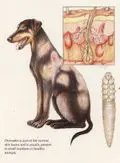 Over the past year, she has been treated repeatedly with high doses of cortisone, topical powders, and occasional systemic antibiotics (for a week, at most). In this year, she has progressed from a recurring small spot here and there, to a third of her body severely affected. She looks a lot like the dog in this diagram from the Hill's Atlas of Veterinary Clinical Anatomy, only a lot worse… not so happy. Pretty unhappy, in fact.
My first skin scraping yielded a ton of mites, and all life stages, from egg to grandpa. Those microscopic bugs are severely damaging her hair follicles, resulting in lots of secondary bacterial infection, which is most of why she's so miserable.
Most dogs carry a few of these mites on their skin, but compensate for it. Their body's defenses prevent the mites from multiplying very much, and you never see a problem. When an adult dog develops a widespread problem, you have to wonder what went wrong. I've sent out bloodwork to look for as many potential problems as I can, but here's what I think happened.
I think that her first veterinarian did a skin scraping and didn't find mites because her initial problem may have been related to something else. Over the last year, she has become immunosuppressed from too much cortisone. She may have had "normal doses" and it was just too much for her, or the doses might have been excessive. At any rate, her immune system got slowed down, and the mites took off.
Nobody checked for mange mites again, because she didn't have them to start with. Treatment was symptomatic and superficial and not very effective.
Today I followed the dermatologist's rule and did a skin scraping first. I did this because IT'S A RULE, and because the dog looked awful and I didn't want to miss anything, AND, since it was my first time to see her, I didn't have tunnel-vision from previous assessments (see my last post on Diabetes).
So now we're treating her skin infection pretty intensively, and NOT giving her any cortisone, and looking for any other problems and starting to treat the mange mites themselves. I'm optimistic that she will recover and lead a normal life.
I'll keep you posted.
In medical school, I had an attending physician who would tell us that if we only knew one diagnosis, or only looked for one diagnosis, we would only find one diagnosis. He was adamant, as you are, that stepping back and doing a thorough review of the problem is imperative when treating a recalcitrant issue. Good for you. I bet this poor collie girl feels better already.
Spot occasionally has those hot spots, but it’s generally not a big problem. This was interesting. I feel sorry for that poor dog, hope she feels better!
I agree with this that the veterinarian did a skin scraping and didn’t find mites because her initial problem may have been related to something else,keep posting for the more valuable information.
by: sphin
Peppy, is a 4 mouth old french bulldog and his testicle have have not drop. Help
Hello, Daniel,
It is possible that the testicles will descend as Peppy matures. However, it is possible that they will not.
It is not desirable to surgically move the testicles to a normal location. This developmental defect is highly heritable. If you did surgery to make Peppy look normal and be fertile, his offspring would probably have the same problem.
If Peppy’s testicles do not reach a normal location on their own, it would be advisable to have them removed. This is more complicated in dogs who are cryptorchid (“hidden testicles”), but should be done. Testicles that are not in the normal location are more prone to disease.
Good luck.
The rash is red, often flakes or oozes, and has small blisters or bumps. There are often excoriations, or areas of broken skin, from aggressive scratching.
I agree with what you did.. We faced similar problems..
https://www.yousendit.com/transfer.php?action=batch_download&send_id=817789614&email=7cff47bb7cdcb76fbfa15e66c81a1961
My dog’s name is Bailey and he has had a major skin problem for the past year. I have spent alot of money in Vet bills. He licks and scratches, and this is the third time this year I spend money on the same kind of pills. His skin has became black, and he’s loosing all his hair, specially in his neck, inside legs, and face (eyebrows); He also smells really bad, no matter how many times I give him baths. Unfortunately, I have been laid off, and now I can’t afford anymore vet bills, I also have to move, and can’t take him with me. Just thinking about it, its hard for me, but I need advice on what to do. I don’t think anybody would want him with the problems he has.
This sounds like a thyroid issue. Thyroid meds are very inexpensive.
Any dog that scratches constantly will develop changes in his skin in response to that trauma. This is true, whether teh cause of the itching is due allergies, skin infections, mange mites, etc.
One change is increased skin oil production, which causes a rancid odor. Another is flaking of the skin.
Long-term scratching can cause the hyper-pigmentationn (darkening) of the skin. There is also a genetic condition in Dachshunds called acanthosis nigricans. The skin in the areas you have described is most often affected.
Long-term yeast infections in the skin can also produce the appearance you describe. We usually treat with anti-fungal shampoos and systemic anti-fungal medications.
I wish that I could give you some helpful advice, but long-distance without seeing the dog, I really cannot prescribe a treatment.
Hi
you helped me before with one dog’s tooth. thank you very much. Now we have a skin issue. Lovely yellow lab, 11yo and her coat continues to be beautiful. her skin appears fine, not red or rashy or anything weird. But there is stuff that is accumulating at the base of the hair in patches. It is reddish, clay-like, and of course we suspect it is digested blood. But it is not hard like flea dirt, and it is gummed on the hair. When washed off, it turns red. It appears in about 3″ diameter sections on her shoulder first, then on her sides and near the root of her tail. Several weeks ago, she wouldn’t eat (very unusual) she was taken to the vet and found to have a fever and we were given an antibiotic. I have searched the internet without luck. Suggestions would be appreciated. thank you
Hello, Pamela,
The fact that it turns red when washed off certainly makes one wonder about the presence of blood.
Your description isn’t ringing any bells for me, I’m afraid.
Time to get a hands-on exam, I’d say.
Good luck.
My 1 1/2 year old blue nose pitibull has developed several circles on his fur that are a different color/dark blue color. Looks like drop of water on her fur. Underneath some of the hair circles are scabs and dryness/flakiness but not all of them. She has lost some fur where some of the circles are. She doesn’t scratch and they don’t seem to itch. No one can figure out what is causing this. She also is limping and it seemed to happen when she developed these discolored circles, though it could be a coincidence. Tested thyroid and valley fever and everything is fine. Any ideas? Thank so much in advance
If this is a continuing problem and standard exam techniques aren’t giving you a clue, then I would suggest a skin biopsy, sent to a dermato-histopathologist – a doctor who specializes in skin disease and microscopic examination of the tissues. If you send it to a regular pathologist, they are unlikely to be helpful. They don’t have the special expertise needed.
Is it okay to bathe a dog after scraping of the skin?
Hello, Yolz, I am sorry to be so late in replying, but our website was re-vamped and the blog comments went into limbo. It should be just fine to give a bath after a skin scraping. In fact, many skin diseases are treated with medicated baths.