

I've had lots going on in the past week, some interesting stuff, but just too many long days. By the time I get squared away, it's time to hit the rack. I hope to be posting again this weekend.
« May 2007 | Main | July 2007 »
I've had lots going on in the past week, some interesting stuff, but just too many long days. By the time I get squared away, it's time to hit the rack. I hope to be posting again this weekend.
Posted at 01:55 PM in A day in the life | Permalink | Comments (0) | TrackBack (0)
There are several reasons for that, but the main thing is that your new puppy wants to be right with you. It's pretty easy to step on him. When we picked Anna (our first family dog together), her breeders said, "Remember to do the Puppy Shuffle". Is that some kind of dance? No, it means to shuffle along, not actually lifting your feet from the floor. As long as you're just sliding along, you can't step on the puppy.
Well do I remember racing across the yard with 4-months old (and forty pounds) Anna, when we collided and down I went. I don't know whether I stepped on her foot and tripped, or she knocked me down and I landed on her. In any event, when we got up, her foot was broken: two of the four metacarpals (those long bones in your hand, that go from the wrist to the knuckles). She's six months old in this picture, and none the worse for the wear.
Young puppies heal fast while they are still in their rapid growth phase. Two weeks in a splint like this was enough to put her right. These splints look like a big plastic spoon with some padding inside, and a recess for the carpal pad on the back of the dog's wrist joint. Sometimes they are called metasplints, spoon splints, or carpal splints. You just add some padding and apply them with stretchy tape. They are pretty good for foot fractures.
Even the "toy-size" splint pictured above was way too big for Missy, here. She only weighs about 2&1/2 pounds. Since she was unsupervised with a couple of pre-schoolers, we don't know exactly what occurred. Mom had given the kids such a dressing-down before they got here that they weren't talking much. Since seven out of eight metacarpals were broken, I'm guessing she got stepped on. Probably everybody was having a great time right before that happened. Could have been worse -- I've seen little dogs who had their heads stepped on. Hard to un-mush them.
With some padding and some tongue depressors (and some pain meds, and a couple of weeks), I think this kid will soon be getting underfoot again. Maybe everyone will have learned the Puppy Shuffle by then. Maybe Missy will learn to walk on her hind legs... and dodge.
Posted at 05:48 PM in Trauma | Permalink | Comments (0) | TrackBack (0)
I've previously offered my thoughts on pets being hit by cars. "Oh, I can't stand to see them penned up." Well, as Charlie Alnutt (Humphrey Bogart) says in "The African Queen", "You pays your money and you takes your choice." [Our high school English and Drama teacher, Mr. Joe Newman was fond of that saying, too.] By which I mean, yeah, you can give them the freedom to run loose, but you have to know that someday they are going to get hit, shot, chewed up in a fight, poisoned by someone's garbage, and so forth.
That sure came home to roost for Buddy last night. Look at the road-rash on that face. He has little cuts and scrapes all over his body, and big bruises under them, too (though you couldn't see them yet, I'm sure he was/is feeling them).
Buddy wasn't critically injured, but he had some wounds that needed attention. After some pain meds and sedation to examine him, we proceeded to start I.V. fluids and get him anesthetized and on some oxygen. After cleaning up the wounds, we first sutured this gash on his right front leg.
You've heard of "ripping somebody a new a________", and this is what it looks like. There were several new holes besides the one he started with. I really can't picture exactly how this happened in the sequence of getting hit and rolled, but obviously it did.
Here's "Frankenbutt" after being re-assembled. Still doesn't look great, but we're down to just the one hole that belongs there. I don't think he's even going to be incontinent. He'll be on stool softeners for a while, though. Pain meds, too, natch.
Posted at 02:40 PM in Trauma | Permalink | Comments (1) | TrackBack (0)
In my last post, one might have a tendency to interpret my comments as being critical of the dog's regular veterinarian. While I do think there is some lapse of logic in sending home a barrier collar instead of (or without) pain medicine, you have to consider this in light of the back-story. Don't judge too harshly.
As hard as it may be for you to believe, routine pain management after surgery has not always been the standard for our profession. As a reformed sinner myself, I must admit that our commitment to routine pain management is only about seven years old. Prior to this, pain medication was only given when the animals were crying. This was sadly inadequate, as it is a non-survival behavior to exhibit how weak you are. Animals are not stoic out of some misguided sense of macho, but rather because the primeval ancestors who advertised themselves as helpless victims did not produce many descendants. So "big girls don't cry", and waiting for the animal to cry is waiting too long.
How could we have had such a callous attitude toward animal suffering? I graduated from veterinary school in 1978. When I took my surgical training, we were told to be very sparing with pain medication, if we gave any. "If you get them feeling too good, they'll run around and tear up your surgery." We were paying good money for our education, and these professors were the best in the west, and so we believed them.
Now you might say, "Have you ever had surgery yourself? Didn't you need something for pain?" I'd answer yes, and yes. HOWEVER, when I had my shoulder reconstructed about one week before starting veterinary school (I was in a sling for the first six weeks), they didn't give me much pain medicine. In those days, being a drug addict was considered "a bad thing". If you got to liking those pain meds, you just might become a drug addict. So, I lay there hurting like hell all day long, and then they'd give me some Demerol at bedtime so I could sleep. That's the way it went for three days, after which the pain had subsided greatly. I don't know whether I'd have become addicted if I had received medication during the daytime, too, but I was sure glad to drift away on my little pink cloud at night.
Since they didn't give people much pain medicine, and the instructors told us not to give pain medicine, it's not so hard to understand how this attitude became pervasive. Attitudes have changed greatly in the past few years. In 1997, Dr. Bob Paddleford talked about pain control, and spent half his time apologizing for recommending it. He knew the old-timers would think he was a sissy. Now we're concerned with multi-modal analgesia (in other words,whether you are using enough different approaches to be sure the pain is under control).
If you have major surgery now, chances are good that you'll have a little "pain pump". If you start hurting, you just hit the button and get some more medicine. In retrospect, I find that when I received post-surgical pain medicine, it hasn't made me want to get up and run around -- it let me rest.
I don't know how long it would take a pet to learn to operate a "pain pump". I do know that I can't wait for them hit their nurse's buzzer. Certainly, when you know a particular individual, you can be alert for changes in attitude, restlessness, and so forth. For practical purposes in the hospital, we just have to look at what we're doing with that animal. Would this be painful if it were happening to me? Then I'll treat my patient as I would wish to be treated (not like I was treated in 1974).
Posted at 08:20 AM in Pain Control | Permalink | Comments (2) | TrackBack (0)
Why not do something about it? My dentist friend tells me of patients who come to him with terribly painful dental problems, such as broken and abscessed teeth, that have gone untreated for weeks to months. When they tell him this, they add, "I just couldn't stand the pain any longer." You might be thinking, "Why were they trying to stand the pain for so long? Why not just get it taken care of?" It might be money, but more often it is the perception that dental procedures hurt worse than the tooth-ache. This is untrue. I have (sad to say) had a lot of dental work done, including several root canals, and the tooth-ache was a lot worse, by far. Yet, I can tell you that there are many people for whom just hearing the words is enough to send shudders down their spine. If you want sympathy, don't tell folks you have a broken leg: "But this will just take a minute!" No, if you want them to leave you alone, tell them you just had a root canal. They will start back in horror, "OH....no hurry...uh, I gots to go now." Then they carefully tiptoe away in an attempt not to catch whatever it is that placed you in that predicament.
There are times when it's not so clear-cut. I have a friend who had terrible degenerative arthritis in his knees. It hurts to stand or walk, so he wasn't doing much exercise, and he's a guy who really enjoys his food. That combination put a lot of extra weight on him, which made his knees hurt a lot worse. "Well, he just needs to lose that weight." Sure he does. But he can't do aerobic exercise because his knees hurt so much, and his knees hurt so much because he's so overweight. Oh, yeah, he could starve it off, but that's easier said than done, even if you aren't a person who really enjoys food.
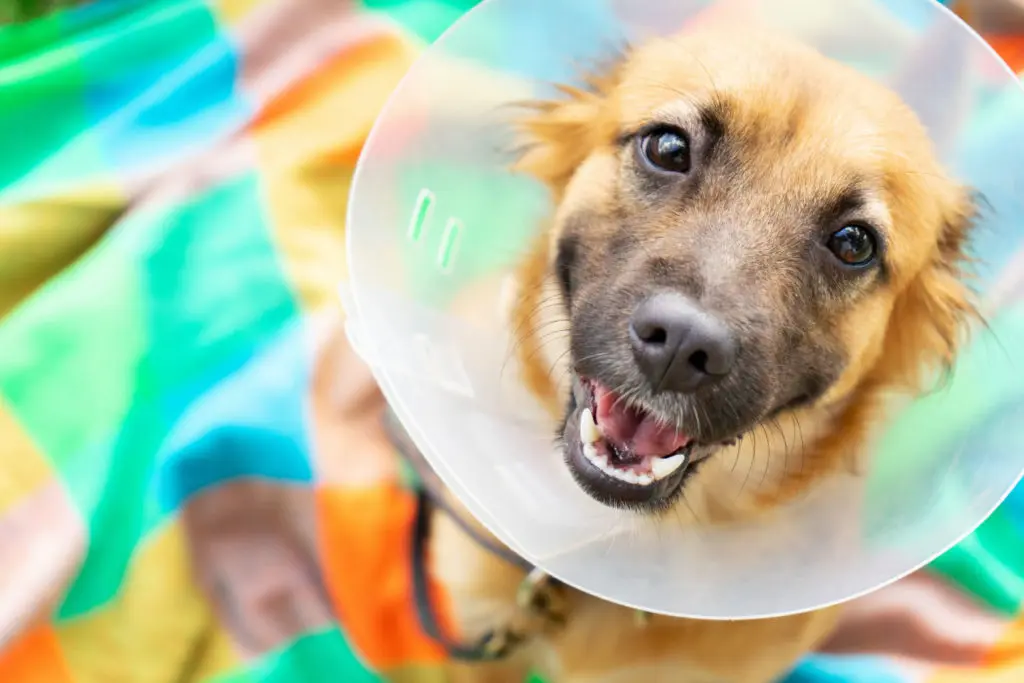
I've talked a little about pain control in a previous post. Here's what stimulated today's diatribe. On my Saturday afternoon off (when I went to lunch at 2:00), I had just sat down to read the paper when the phone rang. "We're here visiting this weekend and our little dog was spayed on Monday and now her incision is bleeding. Could you take a look at it?" I could, I did. One end of the incision was draining some nice pink pus. Well, that's not supposed to be happening. The sutures seem to be holding fine, but she obviously has gotten it infected. "Is she licking it a lot?" "Oh, yes; we can't keep that hood on her." By hood, they meant an Elizabethan collar.
Here's Queen Elizabeth the first of England. Note the fashionable collar, or ruff. That's not what I'm talking about.
This is what I'm talking about.
Or maybe this. It's a device to keep the dog from getting it's mouth onto anything but the food bowl. Sometimes it works.
"It's been five days since her surgery, so I guess she's probably out of her pain medicine." "They didn't give us any pain medicine. Should we have asked for some?"
Let me get this straight, now: we send home the E-collar because we're afraid that the dog will lick at the wound. It is apparently common for that doctor's patients to lick their incisions a lot. Could this be because the incision is painful? I know any incisions on me have been painful (but I'm not flexible enough to lick them, even if it would help, which it doesn't.). If you KNOW it hurts, wouldn't it make more sense to give pain medicine than to just try to block the dog's attempts to assuage the pain? Hmmm?
I'm not against the E-collar. There are definitely times when you need to restrain the dog's mouth, even though he's full of pain meds. Some dogs feel that they can chew out whatever's in there hurting them, and that ain't right. It doesn't help, and it screws things up.
I'm not too big on taking drugs as an answer to all of life's problems. Taking a pill because you're shy at parties is not a good thing. On the other hand, if you've just had a painful surgery, I think it's okay to take pain medicine for a few days. If you have just performed a painful surgery on a pet, I think it's mandatory to send home pain medicine for a few days. You can't wait for the dog to ask for it.
Posted at 03:28 PM in Pain Control | Permalink | Comments (0) | TrackBack (0)
Many folks have heard that "chocolate is poisonous to pets". As far as that goes, if you eat a massive enough amount, it's poisonous to people, too. Yes, yes, I hear you out there saying that chocolate is actually an essential nutrient, that you can't live without it (or life isn't worth living without chocolate, or something like that). Yes, I know that a small amount of dark chocolate is considered beneficial to your heart. I eat some every day, though it's mostly because I like it --the heart benefit is just serendipitous. Dogs are different than people and DO NOT require chocolate in their diets.
The toxicity of chocolate is very much dose-related, and generally speaking, it takes a pretty massive amount to be poisonous. When someone calls me in a panic because their dog ate an M&M, they are beating themselves up for nothing. Theobromine is the toxic compound in chocolate, and in large amounts it can make your heart race, give you vomiting and diarrhea, cause seizures, and even death. For a great discussion from VeterinaryPartner.com, check out this link to "Chocolate Toxicity". You'll see from the table at the bottom, it takes a LOT of milk chocolate, and quite a bit of dark chocolate, although it doesn't take very much baking chocolate at all. That's why when Fifi gets a couple of Hershey's Kisses, we're not too worried.
So, when Kaiser's mom asked if eating Hershey's miniatures would hurt him, I said, "Unless he ate handfuls, I wouldn't worry too much." She went home and found that between Kaiser (73 pounds) and his roommate Dixie (13 pound Min-Pin), they had gone through most of three pounds. Now, doing the math (if you followed the link and looked at the chart), you'd see that Kaiser would have had to eat 63 ounces of milk chocolate, and we only had 48 ounces total.
Plus, there were a number of partially mangled bars that didn't get eaten. Dixie, on the other hand, would only have to eat 13 ounces, and even less if she concentrated on the "special dark chocolate" (my favorite). So Kaiser is bigger and greedier, and might have eaten it all. BUT, Dixie is younger and faster, so how do we know who ate how much? And who likes the "Mister Goodbars" and who likes the "Krackels"? And for that matter, who ever buys a full sized Krackel bar? I've never seen one outside of the miniatures.
Fortunately, we were within an hour of the ingestion, so the order of the day was to induce vomiting in both dogs. As it happened, Dixie only brought up a few specks of chocolate and wrappers. Kaiser, however, while he may have eaten less than a poisonous dose... well, you could have fooled me.
Talk about your chocolate mess. It may not have made Kaiser sick, but the rest of us were getting pretty queasy by the time we had everything cleaned up. After they finished vomiting, we gave them some activated charcoal (the "universal antidote": it acts like a chemical "sponge" to soak up toxins in the gut) to be on the safe side. I anticipate that all will be well, but we won't be serving any pudding at staff meetings for a while.
Posted at 07:49 PM in Toxins | Permalink | Comments (1) | TrackBack (0)
Before I went to the Wild West Arts Convention, I was doing a hard cardio-vascular workout every day, and going to the gym twice a week to lift weights. When I returned, I came down with a bad bronchitis that lasted for a couple of weeks, more or less. I still didn't have much wind when I quit coughing. I was pretty slow to get back into my exercise routine, doing cardio only three times a week. I have finally (last two weeks) gotten back into my daily routine, but no weight-lifting. Today was the first day back in the gym after two months off.
I had to drop from six sets to four, and drop the weight by 25%, about what I was lifting in February. It's a little dismal to look at your notebook and see how much ground you've lost. On the other hand, I'm still ahead of where I was last fall. I have some tendency to overdo things, so being patient in returning to my workouts is a little bit of a challenge.
People sometimes ask me what my goal is in working out -- what point do I want to reach? The answer is not so cut and dried. I don't have a bench-press goal, and I'm certainly not going to impress the girls. It's just that when you get to a certain age, you either work at getting stronger, or you get weaker every day. If I'm going to be physically able to wear all my hats, I need to be in good shape. I can't lift dogs, dodge horses, and climb ropes if I'm a couch potato. And that's not to mention my hereditary risk of heart disease.
So, it was hard to start back after two months off. I know I will be seriously sore this week. But, as they say, whaddayagonna do?
Posted at 02:56 PM in A day in the life | Permalink | Comments (0) | TrackBack (0)
Sometimes that seems obvious. If a patient is having blood in the urine, you ought to examine a urine specimen. So the folks bring their baby in, and she takes a little walk outside with our top urine-catching technician, and back they come with a dandy sample. She's emptied her bladder and you've got a great specimen to analyze. Whoops! The analysis shows rafts of weird cells along with the blood cells when you look under the microscope. We need to perform an ultrasound scan of the bladder, and for that, we need the bladder to be full...you know, the bladder we just emptied. Nuts. This happened yesterday, and we wound up keeping the dog overnight and performing the ultrasound this morning. The scan confirmed my suspicion of a tumor in the urinary bladder. Fortunately, we were able to remove it surgically with no trouble (though pathology results may very well send us to chemotherapy follow-ups).
Last month, a huge Rottweiler comes in with complaints of occasional blood in the stool. He looks great and seems to feel great otherwise. Stool exam shows nothing out of the ordinary. The owner says she can't afford a lot, so we start with a broad-spectrum de-worming (Panacur/fenbendazole), and a course of metronidazole (an antibiotic that has an anti-inflammatory effect on the colon wall, while killing bacteria that thrive without oxygen, as well as killing many giardia, the one-celled intestinal parasites).
That didn't work. We've got persistent (if intermittent) blood in the stool. We need to do a colonoscopy. We love that, especially the multiple enemas needed to clean him out first. Oh, well, at least he's so big that it will be hard to deal with the size of the mess. Wait... that's not a positive. Anyway, we get it scheduled.
He comes in today, and we find that he no longer feels great. He hasn't eaten for the last two days. He still looks great, though he's lost a couple of pounds (from his big 120 fighting weight). We give him a couple of enemas, then take an X-ray to see if he's empty. He's empty, and we don't see much remarkable. Next step, light anesthesia for the colonoscopy. Hey, I think I'll just take a quick peek around his abdomen with the ultrasound before we send the scope up the back way.
So we have him asleep, on his back, and I smear some gel on his tummy. Well, now, I've tried to examine his abdomen on previous visits, but this is the first time he's really been relaxed enough for me to get a good touchy-feely on his tummy. I feel something big and hard and not-supposed-to-be-there. You can't really see it on the X-ray, so it must be about the same density as normal tissues. No colonoscopy for you, pal. It's time for exploratory surgery. Jeez, if I'd only anesthetized him to feel his abdomen on the first visit I could have skipped all these other tests.
Have you ever heard that silly question, "Why is it when you're looking for something, it's always in the last place you look?" What we'd like is for the first place we look to also be the last place you look (when you find it, naturally, you stop looking). The bottom-line take-home message here is that the only way for me to know which test to run first would be for me to already know what the problem is. Of course, then I wouldn't need to run the tests.
It takes us back to how much testing is enough? You can't have irony-poor blood in this profession.
Posted at 03:46 PM in Diagnostic Testing | Permalink | Comments (0) | TrackBack (0)
This is Lucy. You can easily see that she is a calico cat, so you know that she must be female (since it's genetically sex-linked: all calico cats are girls). What you can't see is that she's only about one year old (she showed up at the owner's home as a kitten one year ago). If you looked at her teeth, you might be able to guess that, though. You also can't see that she's an "outside cat" from this picture, but the folks are happy to tell you that (from the number of fleas she's carrying you might have suspected it ).
Now that you know she is one year old, lives outside, and is a pretty girl, can you guess whether she is pregnant or not? Her owner acted shocked when I told her the joyful news. "How could that happen?!" Actually, a more appropriate question would be how could it NOT have happened?
Cats are seasonally poly-estrous. They are not like dogs. A female dog has reproductive cycles (estrous cycles, "heat" cycles) that last around 3 to 4 weeks, and most of them cycle twice per year, at no particular time. Cats shut down the kitten-maker in the late fall and winter, when the food supply is less certain for them (in nature, anyway). With spring, they begin to cycle constantly. They are "in heat" (sexually receptive and fertile) for four days, out for eight, in for four, out for eight, in for four, etcetera. This continues until the cat gets pregnant, or next winter, whichever comes first.
A cat in heat tends to act a little crazy, yowling and assuming odd postures and behaviors. I have made more than one night call for a "dying cat" who proved to simply be in a lusty mood.
Cats are induced ovulators, which means that the ovaries don't release the eggs until mating takes place. This means that when cats are trying to make babies, they don't "miss the day" of ovulation. When it comes to getting pregnant, they are reliable little machines.
After nine weeks of gestation, here come the kittens, and aren't they cute? Now she nurses them. You'd think she'd be too busy doing this to get pregnant again, but you'd be wrong. It's quite common for the queen (the momma) to be two weeks pregnant by the time the first litter are weaned.
Cats in Lucy's situation usually crank out two litters per season, and three is not uncommon. That's why it would have been kindly old Doc Mobley who was shocked had the cat NOT been pregnant. If you don't want new kittens around the homestead, you had better hurry up and schedule some surgery for those nubile young cats.
Posted at 03:45 PM in Reproduction | Permalink | Comments (2) | TrackBack (0)
Lots of summer birthdays in my family. I recently turned 54, as did my wife. One brother just turned 47 and the other will soon be 50. Mostly I'm glad to be here.
Sometimes, though, this Dilbert cartoon speaks to me.
Many happy returns of the day... to all of us.
Posted at 05:46 PM in A day in the life | Permalink | Comments (2) | TrackBack (0)